
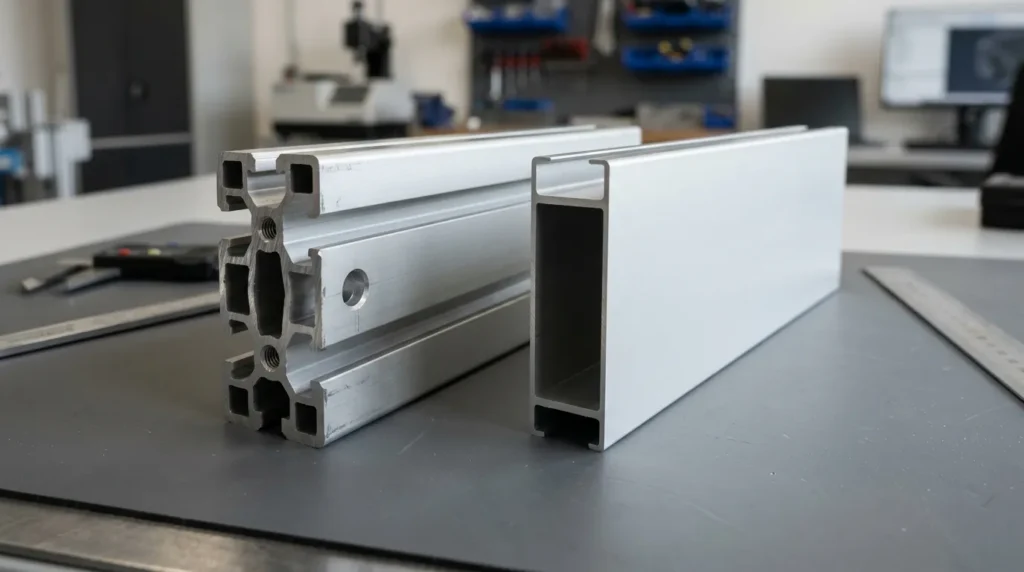
6061 aluminum and 6063 aluminum are both heat-treatable alloys in the 6xxx family, but they solve different extrusion problems. Choose 6061-T6 when strength, structural performance, machining or hard anodizing drive the design. Choose 6063-T5 or T6 when the part needs an intricate profile, a good visible surface, color-critical anodizing or higher thermal and electrical conductivity.
The alloy name alone is not a specification. Temper, product form, governing standard, finish and the intended load path can change the answer. This guide compares the two grades in the conditions most often used for extruded profiles and gives a practical selection sequence for engineers and buyers.
Quick Comparison: 6061 vs 6063 Aluminum
| Decision | 6061 aluminum | 6063 aluminum | Practical implication |
|---|---|---|---|
| Common extrusion temper | T6, with T4 and T5 also available | T5 or T6 | Do not compare alloy names without comparing temper |
| Chemical character | Higher Mg and Si; contains Cu and Cr | Leaner Mg and Si; very low Cu and Cr | Chemistry affects strength, extrusion response and finish |
| Typical strength | Higher | Lower to medium | 6061 is normally the structural choice |
| Extrudability | More demanding, especially for the T6 route | Generally easier for intricate profiles | 6063 is often the lower-risk choice for complex shapes |
| Visible surface | Can be extruded and finished, but appearance is more alloy-sensitive | Widely used for architectural and anodized profiles | Approve a finished sample for color-critical work |
| Anodizing | Suitable; often selected for hard anodizing | Excellent general anodizing response; common in architectural clear anodizing | Both can be anodized, but they are not interchangeable for color matching |
| Corrosion | Good | Good, with a leaner chemistry that suits many architectural applications | Verify the environment and protective finish |
| Machining | Better for many machined features | Average | 6061 is often preferred when secondary machining is extensive |
| Good first choice for | Structural frames, brackets, machined components and hard-anodized parts | Window and door profiles, trim, railings, heat sinks and complex visible extrusions | Selection follows function, not a universal ranking |
Same 6xxx Family, Different Chemistry
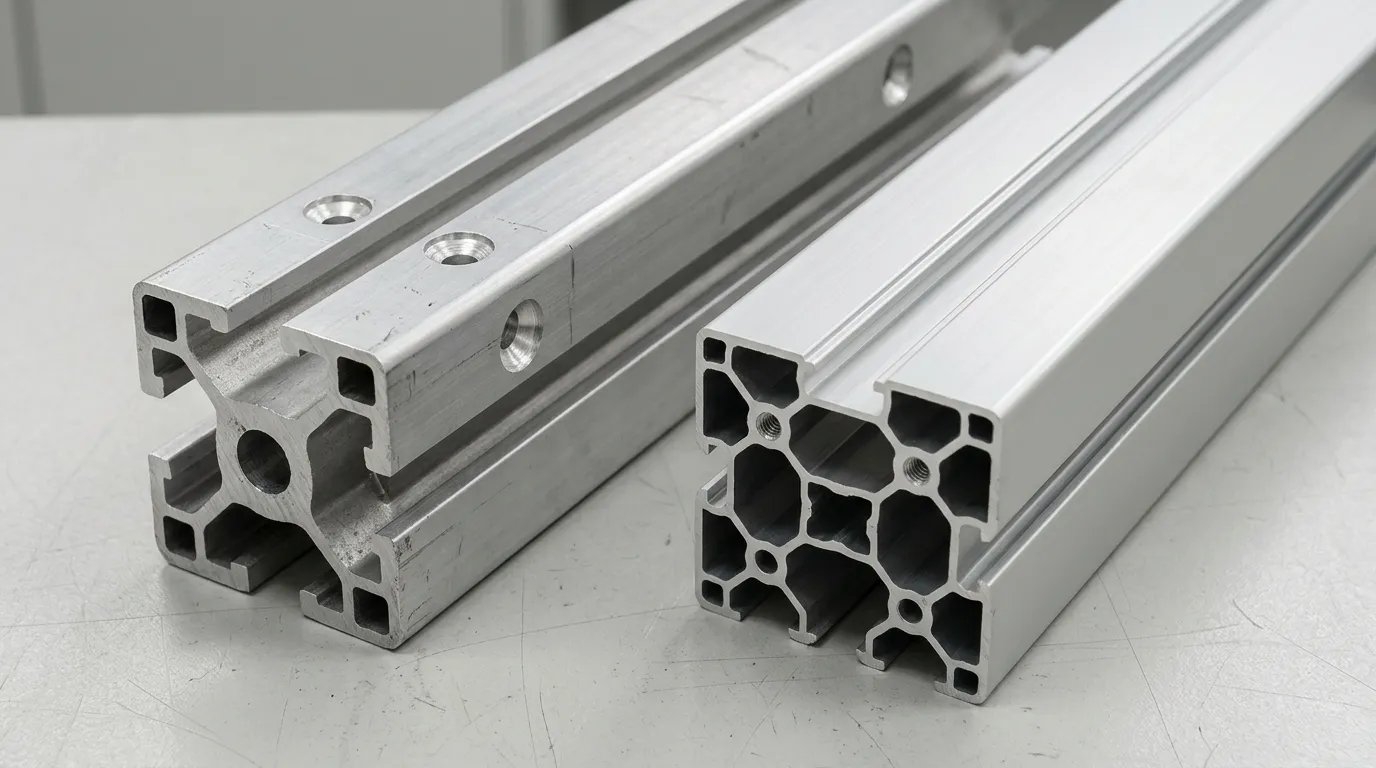
Both alloys use magnesium and silicon as their principal alloying elements, which is why they can be strengthened by heat treatment. The differences in the registered composition limits explain much of their behavior.
| Element or property | 6061 | 6063 |
|---|---|---|
| Magnesium (Mg) | 0.8–1.2% | 0.45–0.9% |
| Silicon (Si) | 0.40–0.8% | 0.20–0.6% |
| Copper (Cu) | 0.15–0.40% | 0.10% max |
| Chromium (Cr) | 0.04–0.35% | 0.10% max |
| Iron (Fe) | 0.70% max | 0.35% max |
| Manganese (Mn) | 0.15% max | 0.10% max |
| Nominal density | About 2.70 g/cm³ | About 2.70 g/cm³ |
These are registration limits from the Aluminum Association’s 2025 Teal Sheets, not a recommended recipe. A supplier may produce anywhere inside the registered range, and small chemistry differences can affect extrusion pressure, surface appearance, anodizing response and mechanical properties.
The practical distinction is straightforward. 6061 has more alloying content and is designed around higher strength. 6063 has a leaner composition and is widely used for architectural profiles where formability, surface quality and anodizing matter. For a broader comparison of grades, see our guide to aluminum profile grades and alloys.
Strength and Temper: Compare the Right Condition
The common comparison is 6061-T6 versus 6063-T5, because those are frequent extrusion tempers. Published typical values show a large difference:
| Alloy and temper | Tensile strength, typical | Yield strength, typical | Elongation, typical | Brinell hardness, typical |
|---|---|---|---|---|
| 6061-T6 | 310 MPa | 276 MPa | 12–17% | 95 HB |
| 6063-T5 | 180 MPa | 140 MPa | About 11% | 60 HB |
The 6061 values are published by AZoM, and the 6063-T5 comparison values are listed by MakeItFrom. They are useful for early screening, not for final design. Use the minimum properties required by the governing product standard, temper, product form and size.
The difference is not just alloy chemistry; it is also the heat-treatment route. The Aluminum Extruders Council explains that T5 material is cooled from an elevated temperature and then artificially aged, while T6 is solution heat-treated and artificially aged. The AEC also notes that 6061 typically requires water quenching and is available in T4, T5 and T6 tempers.
That matters for extrusion. A stronger final temper can require tighter control of quench, distortion, straightening and aging. For the same profile, a 6063-T5 part and a 6061-T6 part may therefore have different dimensional behavior even before machining.
ASTM B221 covers aluminum and aluminum-alloy extruded bars, rods, wire, profiles and tubes and specifies chemical-composition and mechanical-property requirements for the alloys and tempers within its scope. It is one common reference, not the only possible one. Projects may also specify ISO, EN, national or customer standards. The important point is to name the exact standard, edition, alloy and temper in the purchase specification.
Extrudability and Surface Finish
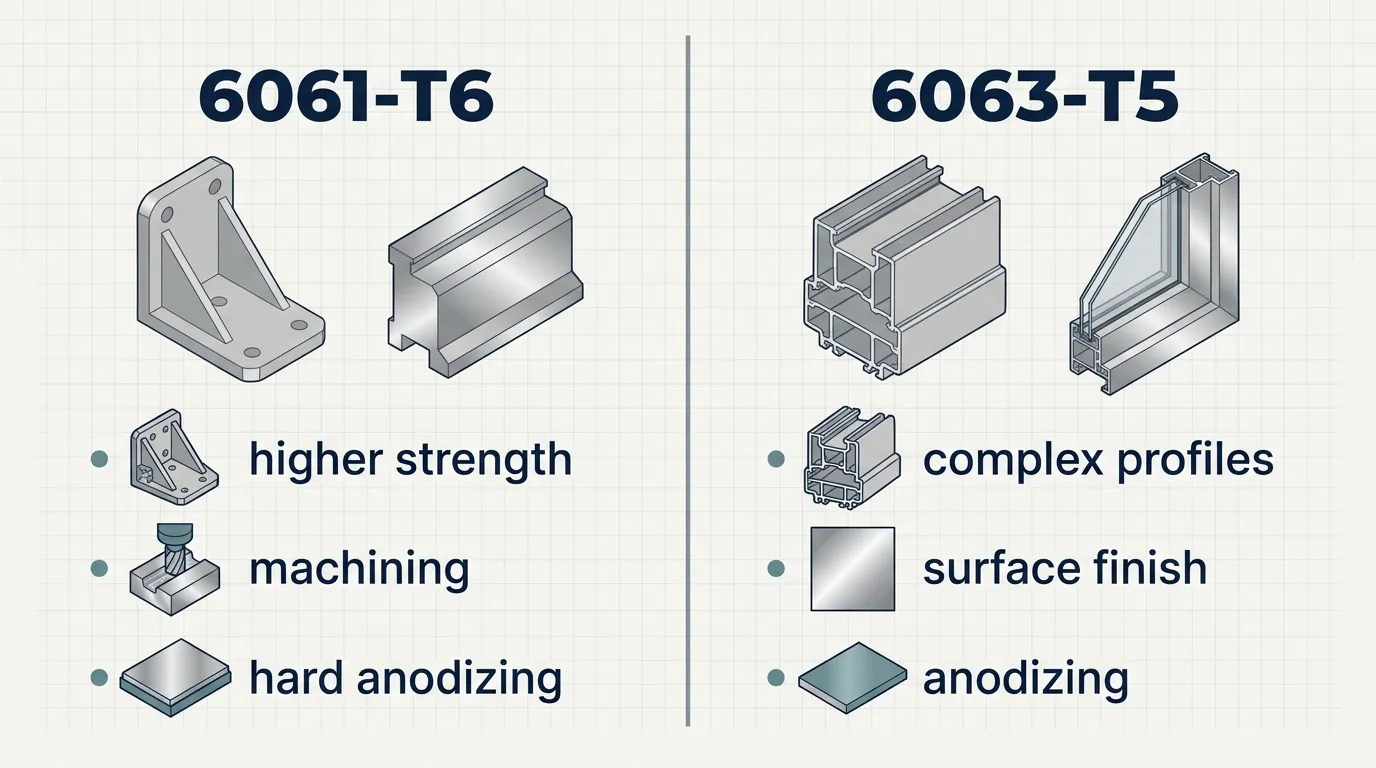
6063 is commonly called an architectural extrusion alloy. A technical profile from AZoM describes it as a medium-strength alloy normally used for intricate extrusions, with a good surface finish, high corrosion resistance and easy anodizing. Those are the characteristics that make it a common starting point for window frames, trim, railing components and other visible profiles.
6061 can also be extruded, but its higher alloy content and higher-strength applications place more demands on the die, press window, quench system and downstream straightening. That does not make 6061 a poor extrusion alloy. It means the supplier should have experience with the specific section, temper and tolerance requirement.
For profile design, use the same rules either way:
- Keep walls as uniform as the function allows.
- Use generous outside and inside radii.
- Avoid isolated thick masses beside thin sections.
- Design around deep, narrow tongues and unbalanced sections.
- Define which surfaces are cosmetic and which are functional.
- State straightness, twist and critical dimensions before quotation.
A die cannot make a poor section inexpensive simply because the alloy is easy to extrude. If the profile has several hollows, thin walls, a large width-to-thickness ratio or a demanding anodized face, review the section with the extruder before freezing the drawing. Our custom aluminum extrusion profiles page shows the type of manufacturing review involved.
Surface expectations should also be written down. “Good finish” is not a measurable acceptance criterion. Define the visible faces, allowed handling marks, die lines, color tolerance, coating thickness and inspection lighting. If the part will be anodized, the alloy and temper belong in that finish discussion from the beginning.
Anodizing Response: Both Work, But They Do Not Look Identical
Both 6061 and 6063 are commonly anodized. The Aluminum Anodizers Council technical bulletin on specifying anodized finishes states that 6xxx alloys offer good general-purpose, heat-treatable properties and an excellent response to anodizing. It specifically identifies 6063 as a popular extrusion alloy with good strength, good luster and a clear-silver anodized appearance.
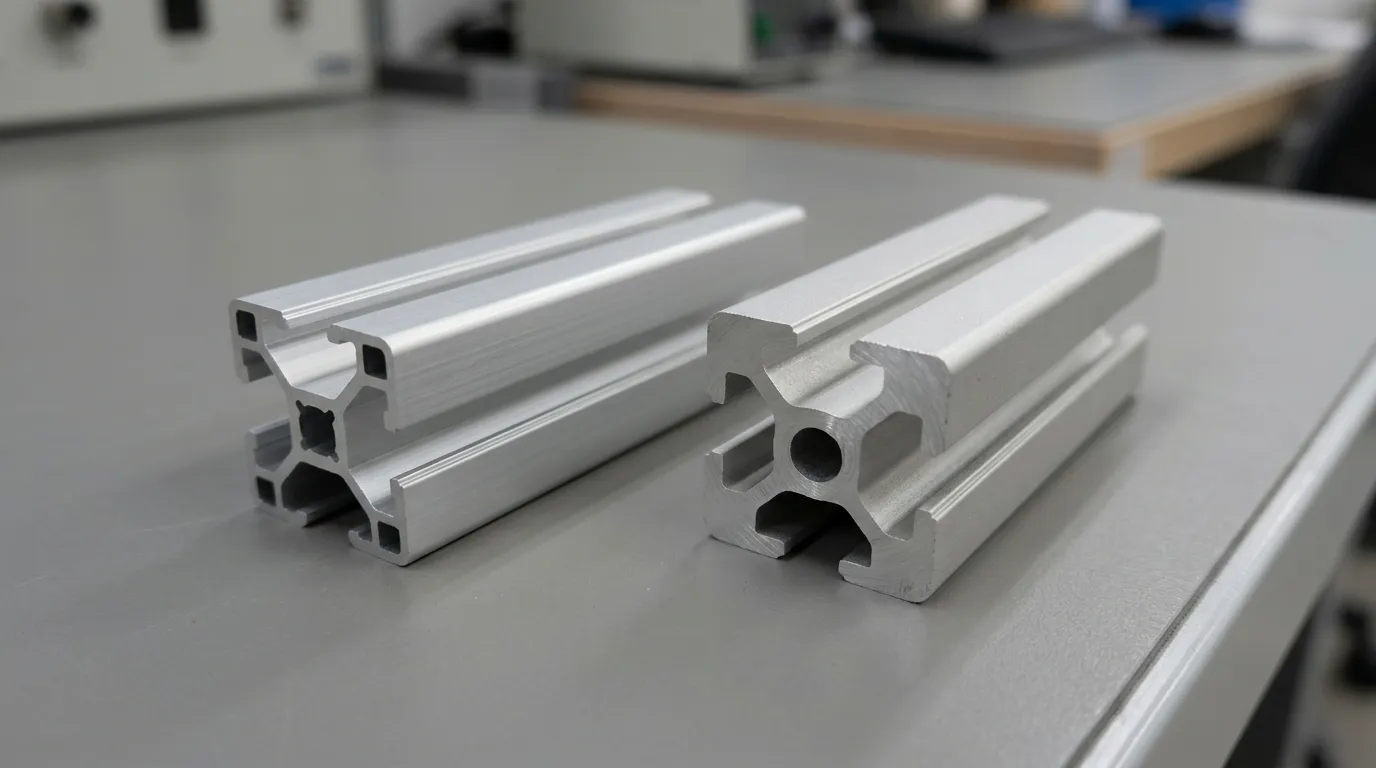
The same bulletin makes an important distinction: 6061 contains more silicon, iron, copper, magnesium and chromium than 6063. It is described as a high-strength structural alloy with excellent machinability and is often a favorite when parts will be hard anodized. The bulletin also reproduces an alloy-reference table that lists 6063 as an anodizing-quality type and 6061 among non-A.Q. types.
That does not mean 6061 cannot be anodized. It means 6063 is usually the safer default when the requirement is a bright, color-critical architectural finish across long production runs. For 6061, confirm the anodizing process, color target, surface preparation and sample approval with the finisher.
The AEC’s anodizing overview explains that the oxide layer is integrated with the aluminum surface and can accept translucent colors before sealing. The process does not hide poor extrusion quality. Die lines, streaks, handling marks and alloy segregation can remain visible after finishing, especially on bright or dark colors.
Use these rules for a finish-critical project:
- Fix the alloy and temper before quoting the finish.
- State the anodizing type and class, coating thickness, color and sealing requirement.
- Define cosmetic surfaces and permitted process marks.
- Approve a production-representative sample from the same alloy and process route.
- Do not promise an exact match between 6061 and 6063, different heats, different extruders or different anodizing lines.
For related finishing guidance, see our article on anodized aluminum profiles.
Corrosion and Welding Behavior
Both alloys have good general corrosion resistance. The AEC describes the 6xxx family as offering good strength, corrosion resistance, machinability, weldability and formability. For exposed architectural work, 6063 is often preferred because its leaner chemistry and established anodizing response make finish control more predictable.
6061 remains a sound choice for many industrial and structural environments, but it should not be treated as automatically equivalent to 6063 in every corrosive service. Copper-bearing alloys and anodic coatings require appropriate process control, and the real environment matters: salt exposure, industrial pollution, cleaning chemicals, trapped moisture and contact with dissimilar metals can all change the result. Specify a protective finish and test method when the service environment is aggressive.
Both alloys are weldable, but welding changes the heat-treated condition. AZoM notes that 6061 is welded with 4043 filler in common practice, with an effect on T6 properties, while 6063 is suitable for conventional welding methods. In either alloy, do not assume that the parent-metal temper remains unchanged in the heat-affected zone. If the joint is structural, design to welded-property allowables and define whether post-weld heat treatment, mechanical property verification or a separate qualification is required.
For structural profiles, the load case should decide the alloy before the joining method does. Our industrial structural aluminum profiles page is a useful reference for that part of the selection.
Thermal and Electrical Conductivity
Alloying elements that increase strength also disturb the aluminum lattice and usually reduce conductivity. This is why 6063 is commonly preferred to 6061 when the profile must also conduct heat or current. Published values vary with temper and test source, but 6063 is generally reported around 200 W/(m·K), while 6061 is commonly reported in the range of roughly 155–170 W/(m·K).
For a heat sink, electrical enclosure or busbar component, compare the complete design rather than one property. Surface area, interface resistance, wall thickness, current density and joining method can matter more than a small difference in base-metal conductivity. See our guide to aluminum heat sink profiles for the thermal-design side of that decision.
Selection Guide by Application
| Application or requirement | Better starting point | Reason |
|---|---|---|
| Window, door, trim and railing profiles | 6063-T5 or T6 | Architectural surface, intricate extrusion and anodizing response |
| Complex thin-walled or multi-hollow profile | 6063 | Usually easier to extrude and finish |
| Color-critical clear anodizing | 6063 | Established anodizing-quality reference and clear-silver appearance |
| Structural frame or bracket with significant load | 6061-T6 | Higher typical yield and tensile strength |
| Extensive CNC machining or tapped features | 6061-T6 | Better machining behavior and higher strength |
| Wear surface requiring hard anodizing | 6061-T6 | Strong structural alloy often selected for hard anodizing |
| Heat sink or electrical conductor | 6063, subject to design | Higher typical conductivity and good extrusion response |
| Welded assembly | Either alloy, after HAZ review | Both weld, but temper and heat-affected properties must be designed |
The table is a starting point, not a substitution for structural calculation. A 6063-T6 profile can be stronger than a 6063-T5 profile; a 6061-T4 profile is not equivalent to 6061-T6; and a thin 6061 section may deflect more than a deeper 6063 section. Geometry and temper often matter as much as the alloy number.
How to Specify the Alloy Without Creating a Dispute
A clear purchase specification prevents the most common problem: the buyer compares alloy names while the supplier quotes a different temper, finish or acceptance standard. Include the following in the RFQ and drawing package:
- Alloy and temper: write “6061-T6” or “6063-T5,” not just “6061” or “aluminum.”
- Governing standard: identify ASTM B221, EN 755-2, ISO 209 or the customer standard, including the edition.
- Product form and size: profile, bar, tube or other form, with critical dimensions and mass.
- Mechanical requirements: minimum tensile and yield strength, elongation and test method.
- Chemical verification: material certificate and, where required, heat-lot traceability.
- Finish: anodizing type and class, color, thickness, sealing, gloss and sample approval.
- Cosmetic and functional surfaces: mark which faces may be visible and which must be masked.
- Tolerances: cross-section, wall, straightness, twist, flatness and machining allowances.
- Secondary operations: cutting, CNC machining, tapping, deburring, bending, welding and assembly.
- Inspection: sampling plan, first-article report and any special characteristics.
Our quality control process follows this principle: the acceptance criteria should be defined before production, not negotiated after the parts are anodized.
FAQ
Is 6061 stronger than 6063?
Yes, in the tempers normally used for extruded profiles. Typical 6061-T6 values are substantially higher than typical 6063-T5 values. The comparison is only meaningful when the temper, product form and governing standard are stated.
Which alloy is better for extrusion?
6063 is generally the better starting point for intricate profiles, visible surfaces and color-critical anodizing. 6061 is usually selected when strength, structural performance or machining is more important. A qualified extruder should still review the specific section and tolerance requirement.
Can 6061 and 6063 both be anodized?
Yes. Both are 6xxx alloys with a good general anodizing response. However, they can produce different colors and surface appearances under the same process, and 6063 is the more common choice for architectural anodizing-quality work. Approve a sample when appearance matters.
Is 6063 more corrosion resistant than 6061?
Both have good general corrosion resistance, but 6063 is often preferred for exposed architectural profiles because of its leaner chemistry, surface finish and established anodizing behavior. The service environment and finish system still determine the final performance.
Can 6061 and 6063 be welded?
Both can be welded, but welding alters the heat-treated temper in the heat-affected zone. For a structural weld, use qualified welding procedures and design to the appropriate welded-property allowables. Do not assume that a T5 or T6 temper remains unchanged after welding.
Does 6063 always conduct heat better than 6061?
6063 generally has higher thermal and electrical conductivity because it contains fewer alloying elements, but the difference depends on temper and application. For a thermal or electrical component, evaluate the complete design, including geometry and interfaces.
Get the Alloy Right Before the Die Is Cut
The right decision is not “6061 or 6063” in isolation. It is the combination of alloy, temper, profile design, standard, finish and inspection plan that meets the application. For a complex decorative profile, start with 6063. For a higher-strength structural or machined component, start with 6061-T6. Then verify the section, heat treatment and finish with the supplier before releasing the die.
Send your drawing, required alloy and temper, finish specification, critical tolerances and expected quantity to contact Yoverd Aluminium for an extrusion review and quotation.