
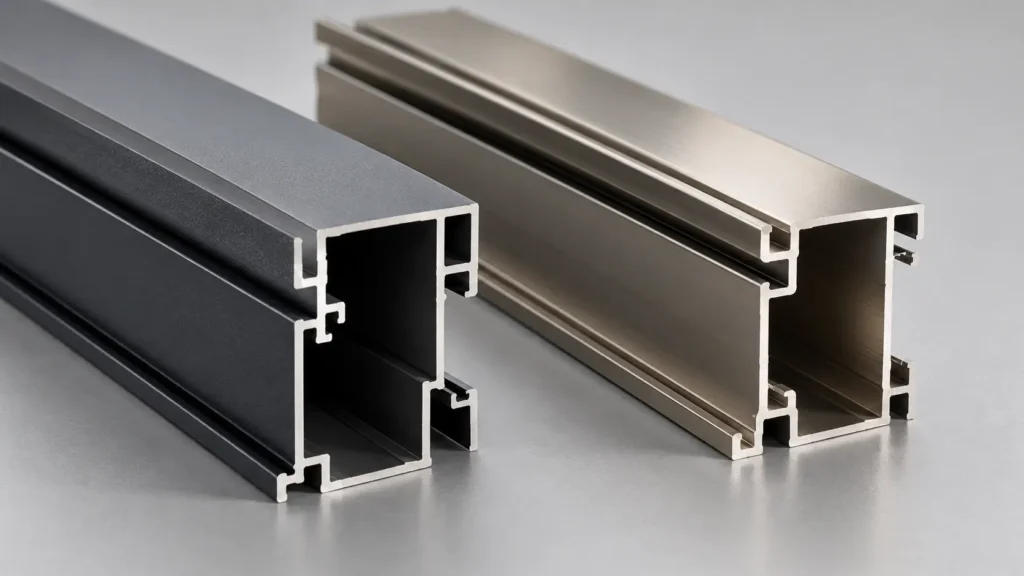
Powder coating and anodizing are both factory-applied finishes for aluminum profiles, but they are not interchangeable. Powder coating aluminum (often written as powder coating aluminium outside North America) is a surface-film route; anodizing is a surface-conversion route. Powder coating builds a cured polymer film on a prepared aluminum surface. Anodizing converts the surface itself into an aluminum oxide layer. The better choice depends on the required appearance, color range, exposure conditions, cleaning and repair strategy, and the performance standard written into the purchase order.
Powder coating aluminum is often selected for color flexibility and design control. Anodizing is often selected for a metallic, integral finish and a hard oxide surface. Neither route is automatically more durable or more expensive. Both can perform well in exterior architecture when the alloy, pretreatment, coating system, thickness, sealing, and maintenance plan are appropriate for the project.
The Two Finishes in One Minute
| Route | What forms the finish | Appearance and color | Strong fit | Main risk |
|---|---|---|---|---|
| Powder coating | A dry powder is applied electrostatically and cured into a polymer film | Broad color, gloss, texture, and special-effect range | Architectural and industrial profiles that need a controlled color or a non-metallic surface | Poor pretreatment, wrong resin for outdoor use, incomplete cure, or film damage |
| Anodizing | The aluminum surface is electrochemically converted into an aluminum oxide layer | Metallic, translucent, clear, bronze, black, or dyed colors | Applications that value an integral metal finish, hardness, and a clean architectural look | Insufficient thickness, poor sealing, chemical attack, or visible scratches |
The practical question is not “paint or metal finish?” It is “which finish system can meet the appearance, environment, inspection, and maintenance requirements at an acceptable total cost?”
How Powder Coating Works
Powder coating begins with a clean, consistently prepared aluminum surface. The profiles are usually cleaned and given a conversion pretreatment, then charged powder is sprayed on and cured under heat. The Aluminum Extruders Council notes that finish selection depends mainly on the desired appearance and the product’s in-use environment. Wikipedia’s powder coating overview describes the powder as a free-flowing material that is normally applied electrostatically and cured with heat; the project specification and coating supplier’s technical data should control the actual pretreatment and cure schedule.
Because powder coating uses no liquid carrier, it can build a thicker film without the runs and sags associated with some liquid paints. The powder may be thermoplastic or thermosetting. Exterior architectural work requires an exterior-grade chemistry: standard epoxy and hybrid systems are generally associated with indoor use, while suitable polyester-based systems are selected for outdoor exposure.
Preparation is critical. Oil, oxidation, dust, or an uneven conversion coating can cause adhesion loss or blisters before the polymer itself reaches the end of its useful life. Adhesion, impact, film thickness, gloss, color, and weathering tests should therefore be tied to production.
How Anodizing Works
Anodizing is electrochemical, not a film deposited on top of the aluminum. The profile is immersed in an acid electrolyte and connected as the anode. Current releases oxygen at the surface, where it combines with aluminum to form an aluminum oxide layer integrated with the base metal. The Aluminum Extruders Council explains that this layer is hard, corrosion resistant, and does not chip or peel like an applied coating.
The oxide is porous during processing. Those pores allow metallic deposits or dyes to create color, after which sealing closes and stabilizes the structure. Thickness, density, alloy, surface preparation, color method, and sealing quality all affect the result.
An anodic coating also has different failure modes from powder. It is harder than the base aluminum, but that does not make it indestructible. The oxide can be scratched or abraded, and inappropriate acidic or alkaline cleaners can attack the surface. Wikipedia’s anodizing overview is useful background, while the AEC industry explanation above confirms that the oxide is integrated with the metal rather than an applied film that simply peels away.
Color, Gloss, and Design Flexibility
Powder coating usually offers the wider design range. Matte, satin, gloss, metallic, textured, and structured finishes are available, and color programs can follow systems such as RAL. QUALICOAT’s weathering programme uses RAL colors and Delta E limits when evaluating color performance, which is why the color standard and measurement method belong in the specification.
Anodizing offers a different appearance. Clear anodizing preserves the metallic character of the aluminum, while electrolytic and dyed processes can produce champagne, bronze, dark bronze, gray, black, and other colors. The finish is usually more subtle and metallic than powder coating.
Color consistency needs attention in both processes. Powder color can be affected by powder batch, film thickness, cure, gloss, and substrate condition. Anodized color can be affected by alloy, etch condition, coating thickness, coloring bath, sealing, and lighting. Approve a physical sample and define a measurable tolerance; a digital chip or verbal color name is not enough for visible architectural work.
Outdoor Durability: What Actually Determines Performance
There is no universal winner because powder coating and anodizing fail in different ways.
Powder performance depends on the alloy, pretreatment, resin and pigment system, film thickness, cure, exposure, and maintenance. A recognized architectural specification should define the tests and acceptance limits. QUALICOAT’s specifications cover plants, equipment, coating materials, and finished products, including adhesion, thickness, impact, gloss, color, corrosion, and weathering tests. In projects that use FGIA/AAMA documents, AAMA 2603, AAMA 2604, and AAMA 2605 describe different levels of organic coating performance on aluminum extrusions and panels. These are voluntary specifications, not badges that a supplier automatically earns; confirm the required edition, coating system, applicator qualification, and test reports. Choosing a powder by color alone is not a durability specification.
Anodizing depends mainly on oxide thickness and density, seal quality, alloy, and service environment. The Aluminum Anodizers Council notes that architectural coatings are commonly specified as Class I at 0.7 mil or Class II at 0.4 mil, and that thickness and density are important indicators of coating life. In FGIA/AAMA-based projects, AAMA 611 is the relevant specification for anodized architectural aluminum. QUALANOD reports that architectural coatings initially 10-25 um thick lost about 0.2-0.4 um per year in urban exposure. Marine loss was similar or slightly lower, rural loss was negligible, and a heavily polluted industrial site reached about 1.2 um per year. These are exposure-study results, not a warranty formula.
For procurement, ask for the exposure class, minimum thickness or coating weight, pretreatment, sealing or cure method, color and gloss tolerances, relevant tests, and cleaning procedure. A thicker layer or a well-known label cannot compensate for the wrong alloy, pretreatment, cure, or seal.
Cost Drivers and Volume Effects
It is misleading to say that powder coating is always cheaper or that anodizing always costs more. The processes consume different labor, energy, chemistry, handling, and quality-control resources.
Powder cost is driven by pretreatment, powder chemistry and color, number of colors and changeovers, masking, rack density, film thickness, curing, and special gloss or texture requirements. Anodizing cost is driven by surface preparation, alloy and racking, process type, treatment time and thickness, coloring method, sealing, color consistency, and scratch prevention.
Volume can change the result. A long single-color run, a project with many colors, a heavily masked part, and a profile with difficult racking can each favor a different process. Ask for a quotation that separates material, pretreatment, application, curing or anodizing, inspection, packing, and likely rework. No public price should be inferred from this article.
Repair and Maintenance
Powder-coated profiles can chip at edges or scratched areas. Small damage may be treated with a matching repair material, but a field touch-up rarely reproduces a factory-cured film. Full restoration usually requires removing the old coating before recoating; Wikipedia describes solvent, abrasive, and thermal removal methods, all of which require process control.
Anodized profiles do not peel like paint, but a deep scratch cannot usually be blended away because the color and oxide are part of the metal surface. Surface dirt or a chalk-like film can often be removed with an appropriate cleaning procedure. The Aluminum Anodizers Council describes anodizing as renewable when contamination is removed without damaging the oxide, but cleaning cannot restore metal that has been gouged or abraded through.
Decide the repair strategy before installation. If edges may be damaged on site, choose between matching touch-up, replaceable sections, or a more protected edge detail. Protect anodized profiles during transport and installation and control the cleaning chemicals used on the facade.
Can anodized profiles be powder coated later? Yes, but not by simply painting over the old surface. The anodized layer must be evaluated and properly removed or prepared, and the coater must confirm the substrate, pretreatment, and powder system. QUALICOAT refers to pre-anodizing as a thin oxide pretreatment for powder coating, which is a controlled production process rather than a cosmetic repair.
Which Finish for Which Application?
| Application | Usually starts with | Why |
|---|---|---|
| Architectural profiles needing a specific color, gloss, or texture | Powder coating | Broad color and appearance range with an exterior-grade system |
| Facades needing a metallic, integral finish | Anodizing | Clear, bronze, and oxide-based finishes preserve the metal character |
| Coastal or heavily polluted projects | Either, with an upgraded specification | Pretreatment, thickness, sealing, corrosion testing, cleaning, and maintenance decide performance |
| Industrial parts needing color and corrosion protection | Powder coating | A suitable industrial powder provides a durable, cleanable film |
| Sliding or wearing parts needing surface hardness | Hard anodizing | Type III hard anodizing is intended for wear resistance |
| Profiles with critical mating dimensions or postforming | Either, with process review | Film build or anodic growth can affect fits; postforming powders must be approved for the bend |
Review the finish with the profile system. A custom aluminum extrusion process should define wall thickness, tolerances, drainage, and assembly details before the finish is finalized. For facade work, review curtain wall aluminum extrusion profiles and architectural aluminum extrusion profiles as one system.
Procurement Checklist
Use this checklist when comparing powder coating and anodizing:
- Alloy and temper.
- Finish route and governing standard or quality label, such as AAMA 2604/2605, AAMA 611, QUALICOAT, or QUALANOD where applicable.
- Exposure class and service environment.
- Minimum coating thickness, coating weight, or anodic class.
- Pretreatment and sealing or cure method.
- Color, gloss, texture, and an approved physical sample.
- Color and gloss tolerances, including measurement method.
- Adhesion, impact, corrosion, and weathering tests.
- Critical dimensions, masking, threads, bores, and assembly surfaces.
- Sampling, traceability, test reports, packing, repair, and maintenance instructions.
Confirm the finish before the die and extrusion process are locked. Review custom aluminum extrusion profiles alongside the finish specification and connect the requirements to the aluminum extrusion quality control process. For industrial work, review industrial aluminum extrusion profiles and confirm whether appearance, wear resistance, insulation, or chemical resistance is the priority.
FAQ
Which lasts longer, powder coating or anodizing?
Neither has a universal service life. A suitable exterior powder can perform well when pretreatment, resin system, film thickness, cure, color, and maintenance are correct. A suitable anodized coating can also last a long time when thickness, density, sealing, alloy, and cleaning are controlled. Compare the specification and exposure class, not the finish name.
Is powder coating cheaper than anodizing?
Not always. Color changes, masking, thickness, racking, pretreatment, curing energy, anodizing time, sealing, inspection, and reject risk all change the result. Compare complete quotations using the same quantity, color, exposure class, inspection, and packing assumptions.
Which finish gives the best color match?
Powder coating usually offers the wider color and gloss range, including RAL-based programs. Anodizing is stronger for metallic clear, bronze, and black appearances, but its range is narrower and alloy and process variables matter. For either finish, approve a physical sample and define a measurable tolerance.
Can anodized aluminum be powder coated later?
Yes, but the old surface must be evaluated and properly removed or prepared. The powder coater must confirm the pretreatment and coating system. This is controlled rework, not scratch touch-up.
Does anodizing peel or powder coating flake?
Anodic oxide is formed from the aluminum and does not peel like an applied film, although it can crack, scratch, stain, or erode. Powder coating is a polymer film and can chip or flake if preparation, adhesion, cure, or damage resistance is inadequate.
Choose the Finish as a System, Not a Label
Choose powder coating when the project needs a broad color and texture range, a non-metallic appearance, or an exterior-grade powder specification. Choose anodizing when the design calls for an integral metallic finish, a hard oxide surface, or a clear-to-bronze architectural appearance.
For either route, define the alloy, pretreatment, thickness, color, sealing or cure, testing, handling, and maintenance requirements before production. When the drawings and performance requirements are ready, contact our team to discuss the extrusion, finishing, inspection, and packing route for your project.