

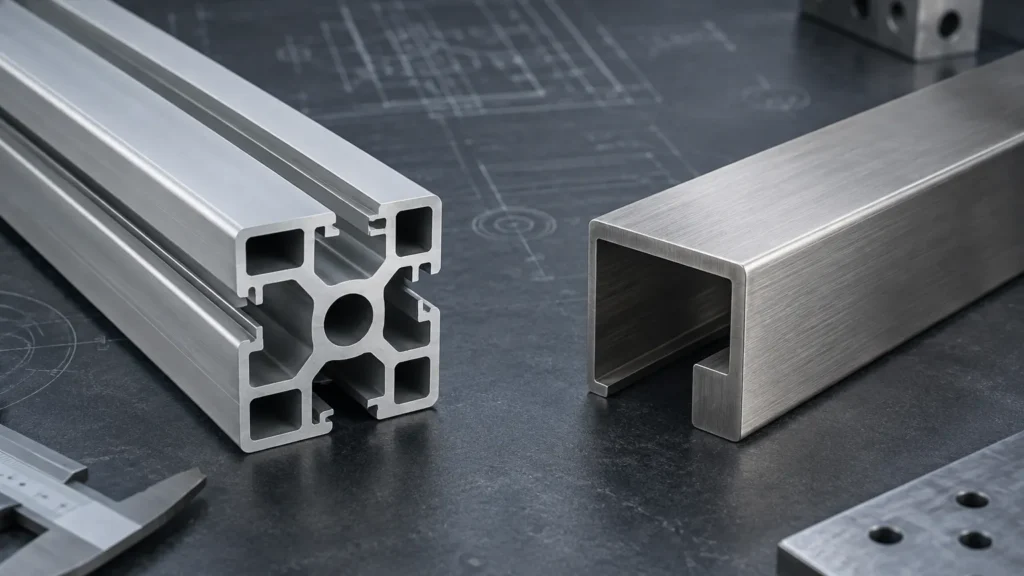
Choosing aluminum vs stainless steel for a profile has no universal winner. Your best option depends on load, allowable deflection, weight, environment, joining, finish, volume, and lifecycle cost. Compare a specified aluminum alloy and temper with a specified stainless grade—not two generic material names.
Quick Decision Matrix
Use this matrix to create a shortlist. It is not a substitute for structural calculations, corrosion review, or prototype testing.
| Design Priority | Aluminum Profile Usually Leads When… | Stainless Steel Profile Usually Leads When… |
|---|---|---|
| Low mass | Moving weight, shipping weight, or manual handling matters | Added mass is acceptable or beneficial |
| Section integration | You want complex grooves, screw ports, hollow chambers, heat-sink fins, or multiple functions in one continuous section | A simpler section can be rolled, formed, welded, machined, or sourced as a specialty profile |
| Stiffness in limited space | You can increase section depth or redistribute material | The envelope is fixed and higher elastic modulus is valuable |
| Corrosion | The selected alloy and finish suit the actual atmosphere | The selected stainless grade suits the chemicals, chlorides, temperature, and cleaning regime |
| Surface appearance | Anodizing, powder coating, or an integrated decorative extrusion is preferred | A bare brushed, polished, or electropolished surface is preferred |
| Fabrication | High-volume cutting, drilling, CNC machining, bending, or modular assembly is central | Wear, heat, impact, or demanding welded service dominates |
| Cost | Finished length, assembly reduction, and logistics favor a light integrated section | Long service life in a severe environment offsets higher mass or fabrication cost |
The first rule is to compare finished systems. A kilogram price does not tell you how much material the section needs, how many parts it replaces, or what it costs to machine, finish, assemble, ship, inspect, and maintain.
Density, Strength, and Stiffness
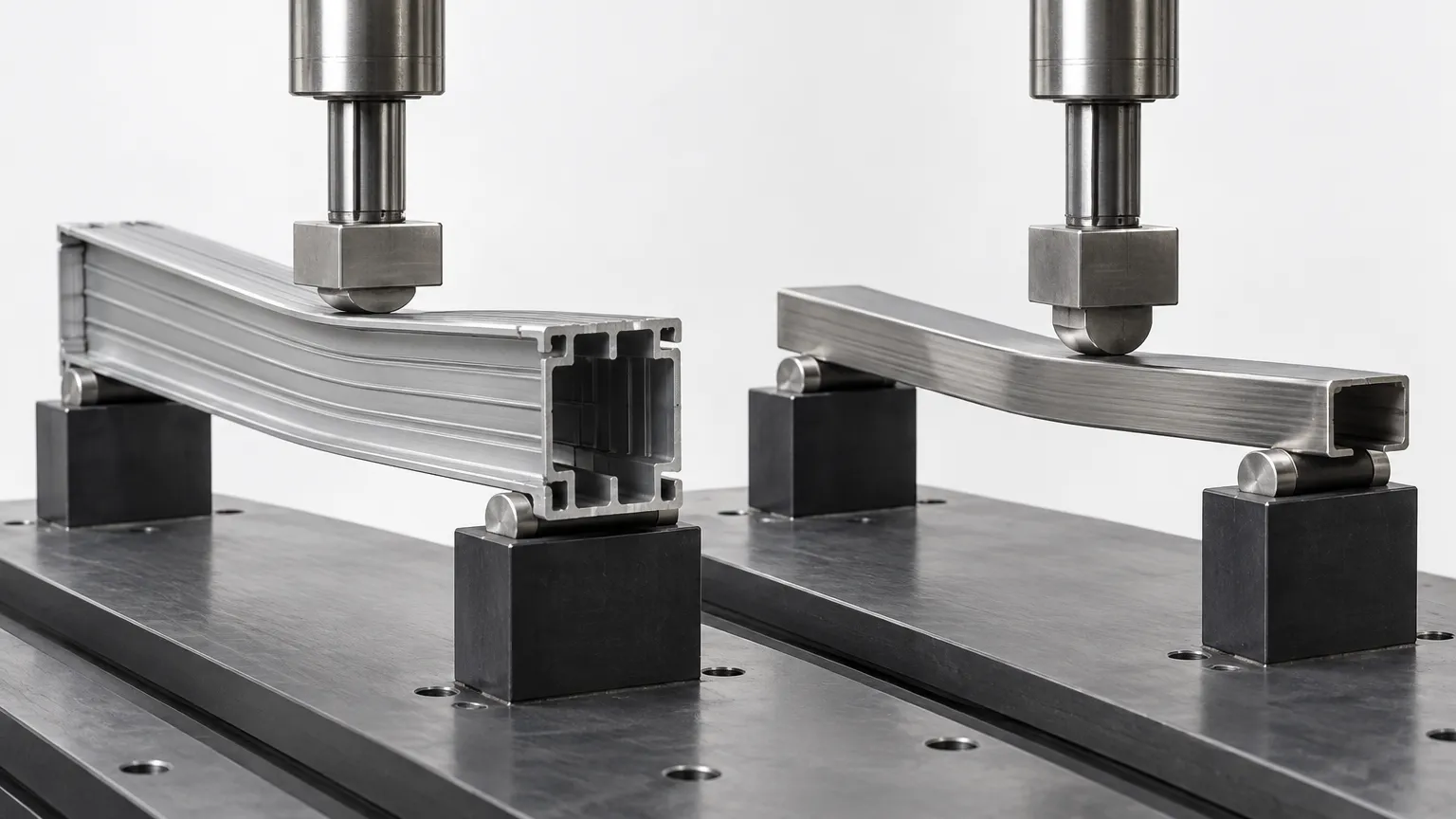
The Royal Society of Chemistry lists aluminum at 2.70 g/cm³. The Specialty Steel Industry of North America (SSINA) lists common stainless grades at roughly 7.7 to 8.03 g/cm³ in its ambient-temperature property tables.
For equal volume, an aluminum part is therefore close to one-third the mass of a typical stainless part.
That does not mean an aluminum section can always replace a stainless section at the same wall thickness. Strength controls yielding or failure, while stiffness controls deflection. Stainless grades generally have a much higher Young’s modulus, so a same-geometry stainless member normally deflects less under the same load.
Aluminum extrusion gives you another design lever: geometry. You can move material away from the neutral axis, add ribs, create closed cells, or integrate mounting features.
A deeper but lighter aluminum section can sometimes meet the stiffness target more efficiently than a shallow section. You must calculate the actual section properties rather than compare handbook strength alone.
Alloy and condition also matter. The Aluminum Extruders Council (AEC) notes that 6xxx alloys combine good strength, corrosion resistance, machinability, weldability, and formability, while the temper determines final performance.
Use our guide to aluminum profile grades and alloys to narrow the aluminum side of the comparison before you request a quote.
For stainless steel, “stainless” covers austenitic, ferritic, martensitic, duplex, and precipitation-hardening families. SSINA’s tables show wide differences in yield strength, tensile strength, density, and modulus among grades and conditions. A fair comparison should name the product specification and condition for both materials.
A Better Structural Comparison
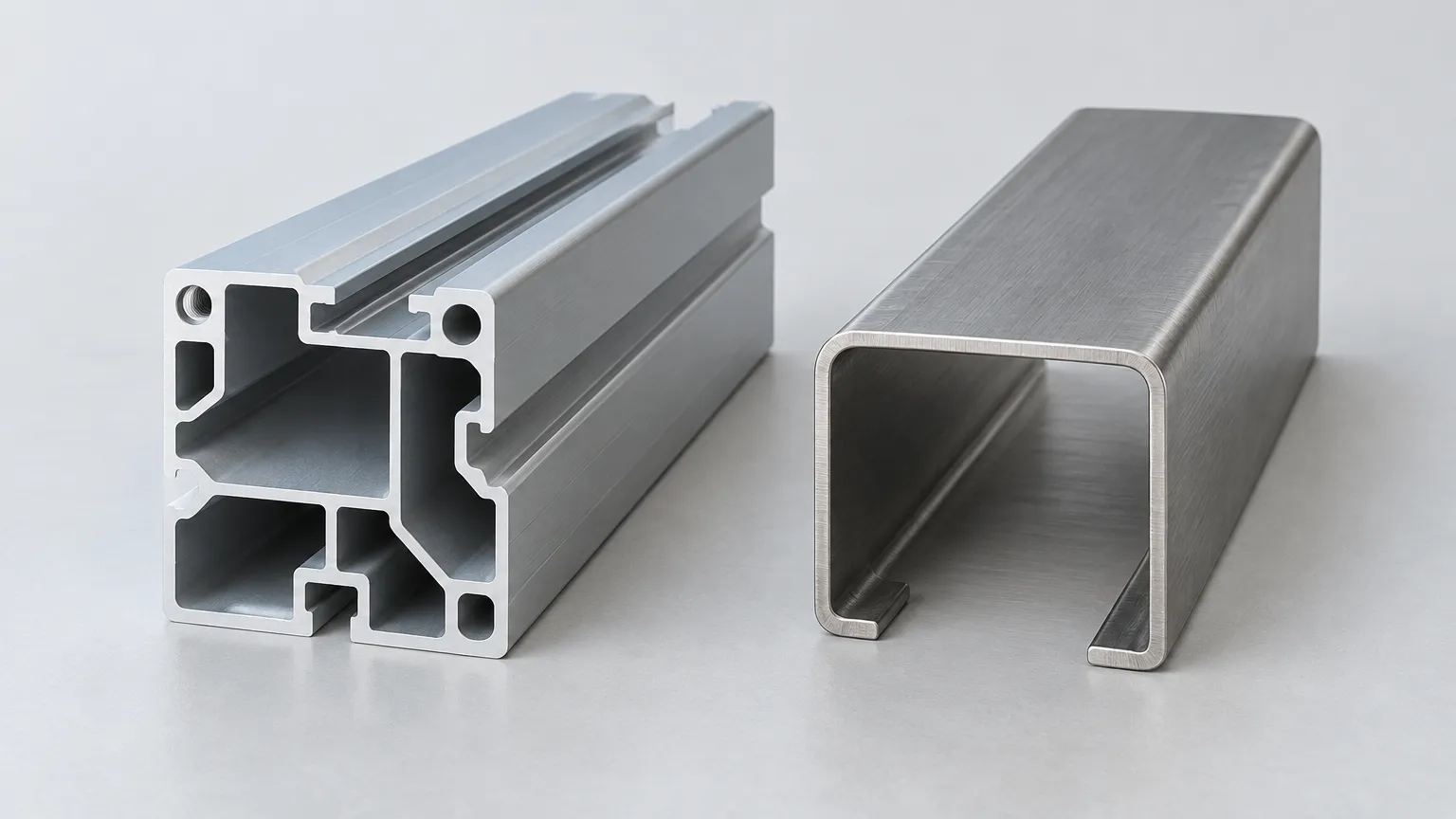
Ask your engineer to compare these items for each candidate:
- allowable stress and required safety factor;
- elastic deflection under service loads;
- buckling length and section slenderness;
- joint stiffness and local bearing around fasteners;
- fatigue spectrum, shock, and vibration;
- temperature range and thermal movement;
- mass per finished length, not density alone.
This approach often produces two different answers: one material may be lighter, while the other is more compact. Your product architecture decides which benefit is more valuable.
Corrosion Resistance Depends on the Environment
Both aluminum and stainless steel rely on protective surface films, but neither material is immune to every environment. The alloy or grade, surface condition, geometry, contaminants, temperature, drainage, cleaning, and contact with other metals all affect performance.
AEC characterizes 6xxx extrusion alloys as having good corrosion resistance and 5xxx alloys as having excellent marine corrosion resistance. That is a family-level guide, not permission to use any aluminum alloy uncoated in any coastal or chemical exposure. You still need the correct alloy, finish, thickness, sealing, and maintenance plan.
worldstainless explains that stainless steel forms a chromium-rich passive oxide film. The same source also warns that crevice corrosion, pitting, stress-corrosion cracking, and galvanic corrosion can occur, often in chloride or acidic conditions. “Stainless” is therefore not the same as “corrosion-proof.”
Environment-Based Questions
Before selecting a material, document:
- indoor, sheltered outdoor, industrial, coastal, marine splash, immersion, or chemical service;
- chloride source, concentration, wetting frequency, and drying cycle;
- cleaning chemicals, temperature, and contact time;
- crevices, water traps, seals, and drain paths;
- expected scratches, abrasion, and coating damage;
- inspection interval and acceptable appearance change.
For an architectural frame, a suitable finished aluminum system can provide low mass and broad color control. For a food, chemical, high-temperature, or wash-down assembly, the right stainless grade and finish may be more appropriate. These are starting points; the actual exposure decides.
Aluminum and Stainless in the Same Assembly
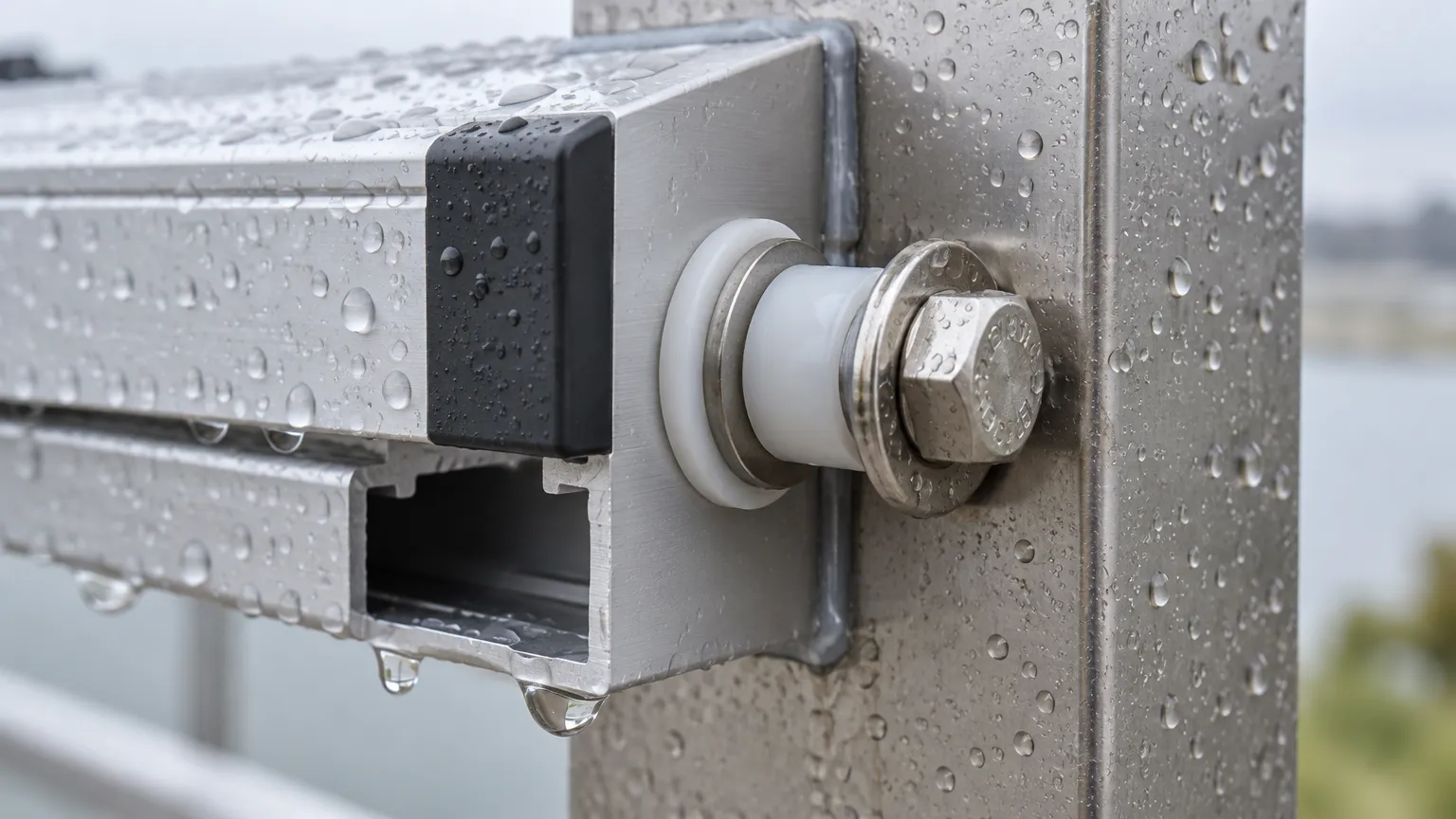
Stainless fasteners are often used with aluminum profiles, but direct contact can create a galvanic couple when an electrolyte is present. worldstainless describes the risk as dependent on electrical contact, the corrosive solution, and the potential difference between the metals.
Reduce risk by reviewing the complete joint. Depending on the project, controls can include insulating washers or sleeves, compatible sealants, suitable coatings, drainage, protected cut edges, and a sensible cathode-to-anode area ratio. Do not assume one isolation detail works for every temperature, load, or service fluid.
Extrusion, Forming, Machining, and Joining
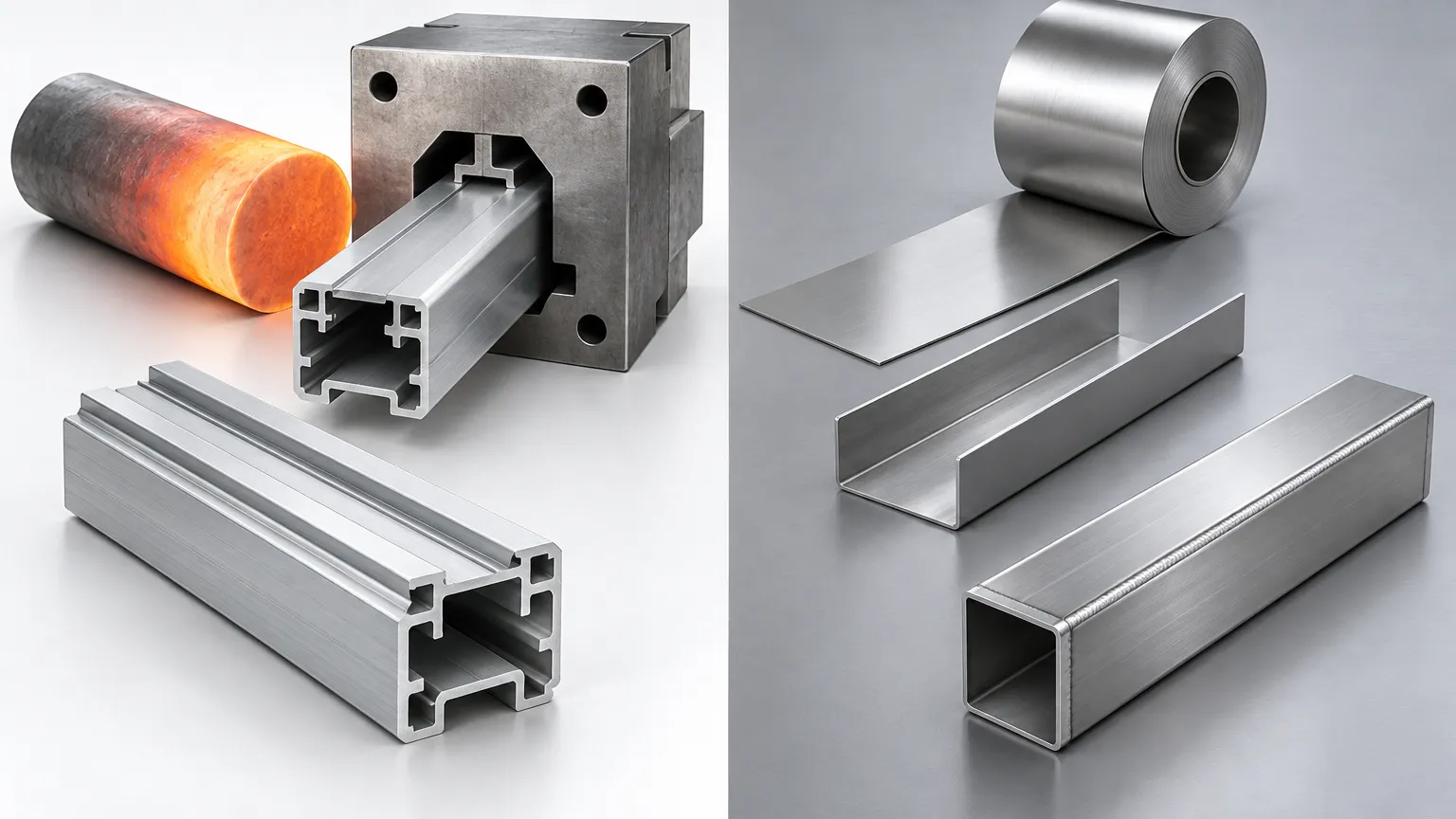
The decisive advantage of aluminum is often not the raw material property—it is the ability to create an integrated section. AEC describes the aluminum extrusion process as forcing a heated solid billet through a shaped die, then quenching, aging, finishing, and fabricating the profile.
Suitable dies can produce solid, hollow, and semi-hollow sections with repeated features along the length.
This lets you replace several brackets, covers, spacers, or rails with one profile. You may integrate screw bosses, T-slots, cable channels, snap fits, heat-transfer fins, or locating surfaces.
Review how extruded aluminum is made and specified before freezing the drawing, because wall balance, tongue ratios, tolerances, and finishing allowances affect feasibility.
Stainless steel profiles can also be produced and fabricated by several routes, including forming, welding, machining, and specialty extrusion. The best process depends on grade, section, quantity, tolerances, and supplier capability. Avoid the inaccurate shortcut that stainless steel “cannot be extruded”; instead, ask which manufacturing route gives the required section and economics.
Secondary Operations
AEC’s fabrication guidance lists cutting, punching, machining, bending, welding, and assembly as common steps for aluminum extrusions. Aluminum generally machines efficiently, but chip control, tool geometry, workholding, dimensional stability, and finish requirements still need planning.
Stainless fabrication requires its own grade-specific controls. The worldstainless fabrication resource covers forming, welding, cutting, cleaning, descaling, and post-weld finishing. Work hardening, heat tint, distortion, tool contamination, and passivation can affect both cost and corrosion performance.
Joining changes the comparison. Mechanical fasteners make service and mixed-material isolation easier. Welding can simplify a permanent frame but introduces heat, distortion, metallurgy, and finish restoration. Adhesive bonding may distribute load and isolate metals, yet it adds surface-preparation and temperature limits. Select the joint with the material—not after it.
Surface Finish and Appearance
Aluminum gives you a wide finish palette. Anodizing grows a controlled oxide layer and can provide a metallic appearance; powder coating provides broad color and texture options. Mill finish, brushing, polishing, chemical pretreatment, and other finishes are also possible.
Your drawing should state the finish standard, color reference, gloss, visible-surface class, and acceptable variation.
Stainless steel is often selected for the appearance of the metal itself. The worldstainless surface-treatment guide distinguishes hot-rolled, 2D, 2B, bright-annealed, brushed, satin, mirror, and electropolished finishes. Finish direction, roughness, weld blending, cleaning, and sample approval can be as important as the grade.
Do not compare “finished aluminum” with an undefined “stainless finish.” Specify what the customer will see and how it will be maintained. A beautiful first sample is not enough if production batches, repair methods, or cleaning chemicals are uncontrolled.
Cost, Maintenance, and Lifecycle Trade-Offs
Material price is only one line in the cost model. Compare the cost per finished, compliant assembly at the required volume.
Include these items:
- Material and section mass: calculate mass per metre or foot from the actual geometry.
- Tooling and setup: include extrusion dies, forming tools, fixtures, gauges, and qualification samples.
- Fabrication: count cuts, holes, machined faces, bends, welds, fasteners, and assemblies.
- Finishing: include pretreatment, anodizing, coating, polishing, passivation, masking, and cosmetic inspection.
- Quality: include tolerances, flatness, surface criteria, traceability, testing, and rejected parts.
- Logistics: compare shipping weight, packaging, handling, and installation equipment.
- Service: include cleaning, coating repair, fastener replacement, downtime, and end-of-life separation.
Aluminum often becomes attractive when one custom profile consolidates parts and reduces assembly. Stainless may justify a higher initial cost when a suitable grade provides the stiffness, wear, temperature, cleaning, or corrosion performance the service requires. The answer can change with annual volume because tooling cost is spread across different quantities.
Application-Based Selection Guide
Machine Frames and Automation
Start with industrial structural aluminum profiles when low mass, modular assembly, integrated slots, rapid modification, and clean cable management matter. Check deflection, joint stiffness, impact, vibration, and wear points. Stainless may be preferable for compact highly loaded members, hot zones, abrasive contact, or severe wash-down service.
Architectural Profiles
Architectural aluminum extrusion profiles are strong candidates for long, repeatable, finished sections with thermal, glazing, drainage, or attachment features. Stainless can suit exposed details where a bare metallic finish, impact resistance, compactness, or a specific corrosion grade is required. Review coastal exposure and mixed-metal joints carefully.
Enclosures, Covers, and Thermal Components
Aluminum is often favored for portable enclosures, heat-sink profiles, electronic housings, and covers because it combines low density, machinability, thermal conductivity, and integrated geometry. Stainless is often favored where abrasion, cleaning chemicals, hygiene, fire exposure, or physical abuse dominate. Confirm sealing and heat transfer at assembly level.
Chemical, Coastal, and High-Temperature Service
Do not select by material family name. Define the chemical, concentration, temperature, stress, crevices, cleaning cycle, and exposure duration. A coated aluminum solution, a higher-alloy stainless grade, or another material may be required. Use corrosion data specific to the environment and obtain engineering approval.
What to Put in Your Drawing and RFQ
Give suppliers enough information to compare viable systems rather than guess your intent.
- application and failure consequences;
- load cases, span, supports, allowable deflection, and safety factor;
- envelope, interfaces, critical dimensions, and datum scheme;
- target alloy and temper or stainless grade and condition;
- reference product standard and required certificates;
- environment, temperature, chemicals, chlorides, cleaning, and design life;
- finish, color, gloss, roughness, visible surfaces, and sample standard;
- joining method, fastener materials, isolation, sealants, and drainage;
- cutting, CNC, bending, welding, assembly, and packaging requirements;
- tolerances, inspection plan, traceability, prototype quantity, and annual volume.
If you are evaluating an aluminum solution, share the drawing, application, environment, quantity, and secondary operations through our custom aluminum extrusion profiles page or send your RFQ requirements. A manufacturability review can identify where geometry may reduce mass, parts, or machining.
Frequently Asked Questions
Is Stainless Steel Stronger Than Aluminum?
Often in absolute terms, but the statement is incomplete without grades and conditions. Stainless families and aluminum alloys cover wide strength ranges. Stainless also has a higher elastic modulus, while aluminum has much lower density. Compare allowable stress, deflection, buckling, fatigue, section geometry, and mass for the actual product—not a generic strength number.
Which Material Is Better Outdoors?
Either can work outdoors when the grade, finish, drainage, fasteners, and maintenance suit the exposure. Coastal chlorides, sheltered crevices, industrial pollutants, and cleaning chemicals can change the choice. Specify the exact environment and desired appearance, then validate a finished system rather than relying on “aluminum” or “stainless” as a guarantee.
Can You Use Stainless Fasteners with Aluminum Profiles?
Yes, but you must assess galvanic corrosion when moisture or another electrolyte can bridge the metals. Review electrical isolation, coatings, sealants, washers or sleeves, drainage, fastener area, structural load, and service temperature. The correct detail is project-specific and should be shown on the drawing.
Can Aluminum Replace Stainless at the Same Wall Thickness?
Not automatically. Aluminum’s lower density reduces weight, but stainless usually provides greater stiffness for the same geometry. An aluminum replacement may need a deeper section, ribs, closed cells, or different joint spacing. Run structural calculations and verify extrusion feasibility before changing material or wall thickness.
Is Aluminum Always Cheaper Than Stainless Steel?
No. Commodity price, alloy, grade, section mass, tooling, volume, machining, finishing, assembly, logistics, quality, and maintenance all matter. Compare the delivered cost of a compliant finished assembly. Aluminum often wins through part integration and low mass; stainless can win where severe service would otherwise add coatings, repairs, or downtime.
Final Thoughts
Choose aluminum vs stainless steel by comparing defined grades, geometry, environment, manufacturing, and lifecycle cost. If an integrated lightweight section fits your project, review Yoverd’s custom aluminum extrusion capability and send a drawing for manufacturability feedback.