

You can use stainless steel fasteners with aluminum profiles. Galvanic corrosion becomes a concern when an electrical connection and moisture create a conductive path between them. To reduce risk, review the joint’s exposure, exposed metal areas and isolation details before ordering. A stainless grade alone cannot protect the aluminum.
For façades, railings, solar support structures and equipment frames, the connection deserves its own specification. You need to consider what happens at bolt holes, cut edges and wet interfaces, rather than judge compatibility from the two material names.
What Causes Galvanic Corrosion Between Aluminum and Stainless Steel?
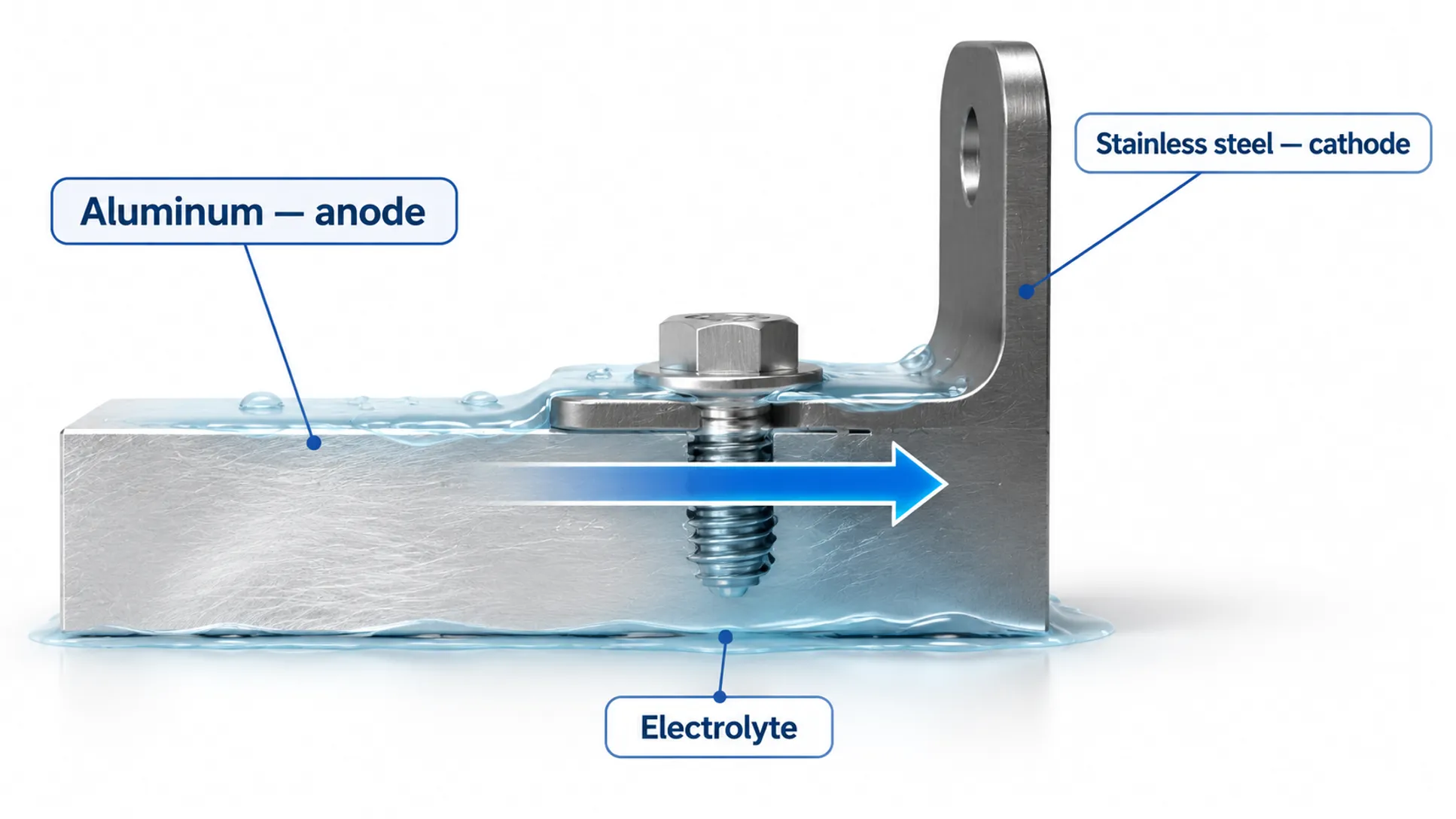
Galvanic corrosion is accelerated attack on one metal when different metals form an electrochemical couple. The FAA’s corrosion-control guidance describes aluminum and stainless steel joined together as an example when moisture and contamination are present.
Three conditions must coincide:
- The metals have different corrosion potentials in the service environment.
- An electrically conductive connection links them, directly or through another component.
- An electrolyte, such as a conductive moisture film, contacts both metals.
In many wet service conditions, aluminum is the less noble partner, or anode, while passive stainless steel acts as the cathode. The aluminum can therefore suffer increased local attack. This does not mean every stainless screw installed in aluminum will produce unacceptable damage.
The Euro Inox technical handbook explains that potential difference alone cannot predict severity. Electrolyte resistance, wetting duration, surface area and reaction behaviour also matter. A galvanic chart helps identify a possible couple; it does not give you a service-life calculation.
Assess Moisture Exposure and Exposed Metal Areas
Identify Where the Joint Stays Wet
Start with the actual connection environment. A sheltered indoor frame and a coastal railing have different wetting conditions. Rain, condensation, salt deposits, washdown water and immersion can each create an electrolyte, but they do not produce identical exposure.
Pay particular attention to covered interfaces. A bracket may look dry on its outer face while retaining moisture underneath. Dirt and stagnant water can prolong wetting in crevices, a risk highlighted in the Euro Inox handbook.
Record how water enters, where it collects and how the joint dries. For marine exposure or regular washdown, ask the responsible designer to assess the complete assembly rather than accept a generic statement that the materials are compatible.
Consider the Effective Cathode-to-Anode Area
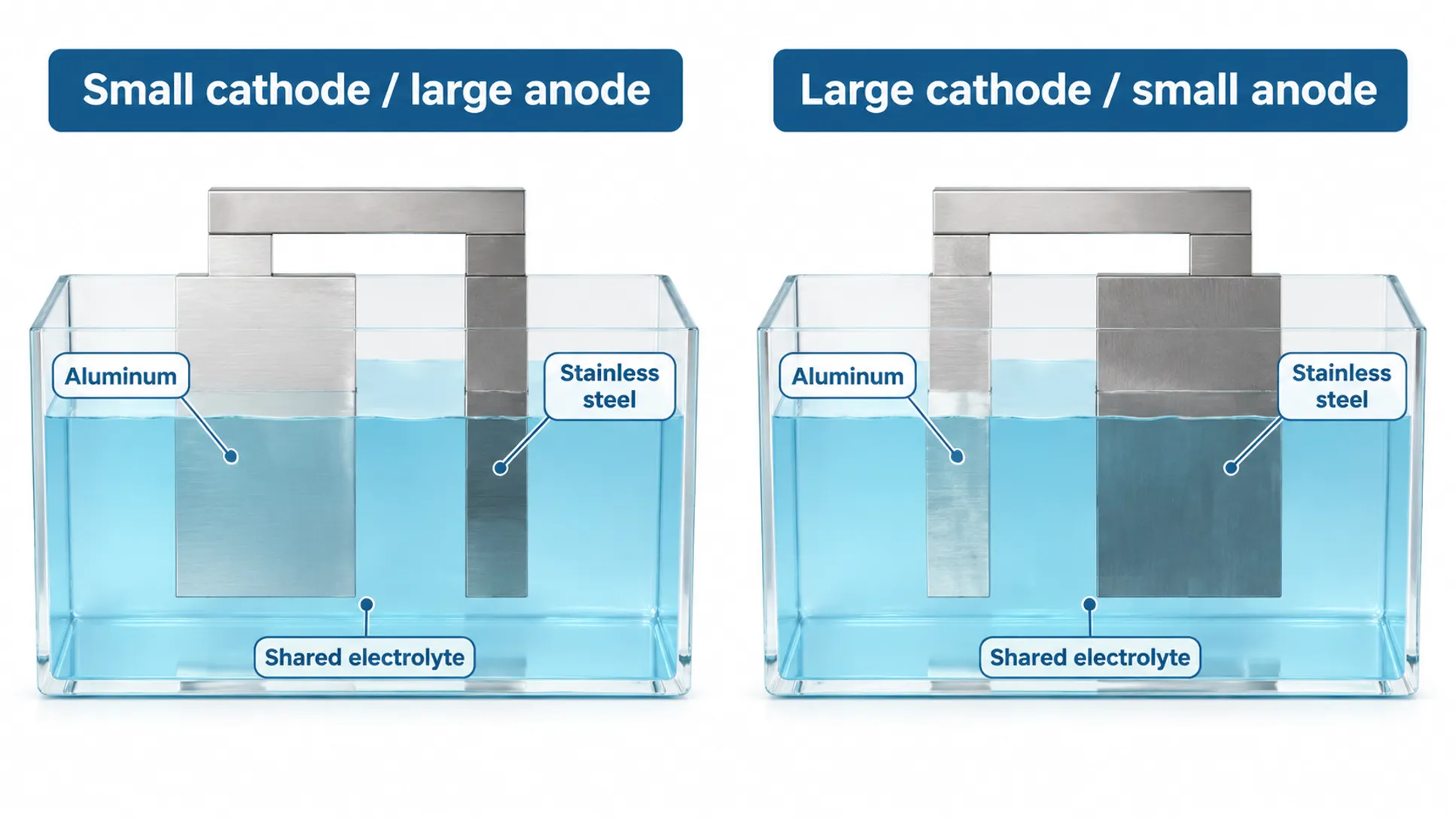
A large wetted stainless surface coupled to a small exposed aluminum area can concentrate attack on the aluminum. Conversely, a small stainless fastener in a much larger aluminum component is generally a more favourable arrangement, provided the environment and protection details are suitable.
Use that principle as a review prompt, not a pass criterion. The effective areas depend on which surfaces are exposed and connected through the electrolyte. The total area of a long extrusion is not necessarily the active area relevant to one wet, damaged joint.
For example, consider an illustrative connection with a broad stainless bracket against a coated aluminum profile. If a wet scratch exposes only a small patch of aluminum, the local arrangement may be less favourable than the component sizes suggest.
This is a design example, not a reported customer failure. Do not assign it a corrosion rate or an acceptable area ratio without evidence for the specific exposure.
Specify Fasteners and Complete Electrical Isolation
Choose the stainless grade for its own exposure requirements, then evaluate its interaction with the aluminum. Changing a drawing from 304 to 316 does not remove the conductive connection or the electrolyte. It therefore does not, by itself, eliminate the galvanic couple.
Where electrical isolation is part of the protection strategy, trace every possible metallic path. These include the bracket face, washer contact, bolt shank, threads, nut and any secondary clip or adjacent hardware.
Why a Plastic Washer May Not Be Enough
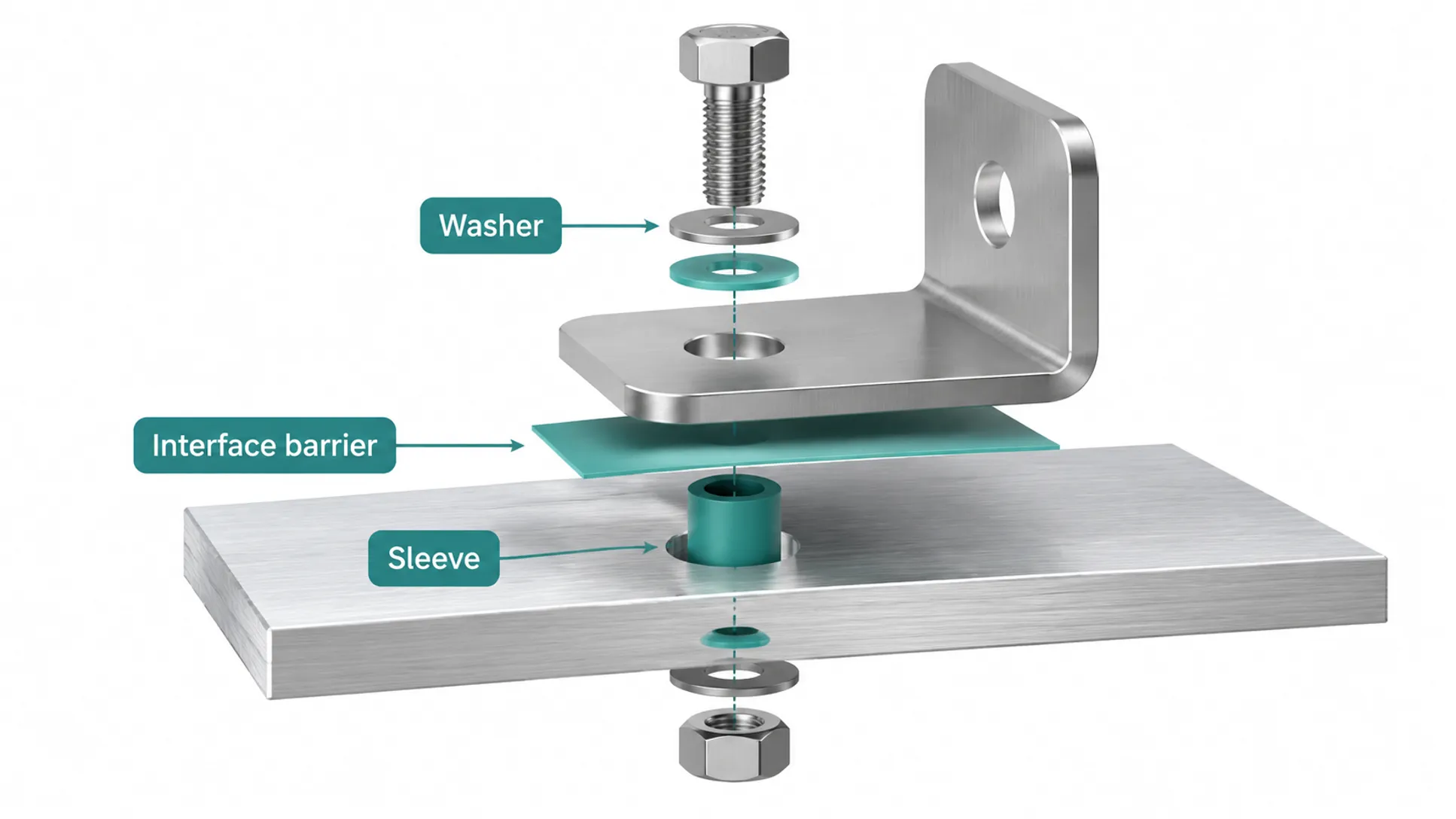
A polymer washer can cover a vulnerable contact area and contribute to protection. However, Euro Inox notes that insulating washers do not interrupt metallic contact at the threads. A washer under the bolt head is therefore not proof of complete isolation.
For a through-bolted connection, the designer may specify compatible insulating washers, a sleeve through the hole and a barrier between mating faces. The required arrangement depends on the joint geometry. A screw threaded directly into aluminum needs a different assessment because the thread contact remains.
Treat this as a detail to resolve on the drawing. Do not assume that adding one plastic part makes an existing connection electrically isolated.
Check the Barrier Under Service Conditions
The isolator also sits in a mechanical assembly. Have the responsible designer review its load-bearing function, compression, temperature exposure, weathering and compatibility with the specified sealant and finish.
Specify the material and arrangement, rather than simply writing “plastic washer.” Ask how the barrier will remain in place during tightening and service, and how assembly inspection will detect an omitted or damaged part.
Electrical bonding or earthing may be required for some equipment and solar structures. Have the electrical and structural designers coordinate corrosion protection with those requirements. Do not remove a required bonding path to create isolation.
Protect Coatings, Cut Edges and Drainage Paths
Anodizing and coating can contribute to surface protection, but the finished joint must account for drilled holes, machined faces, cut ends and assembly damage. Specify which operations occur before finishing and how later damage will be assessed or repaired.
Avoid treating a finish on the aluminum alone as permanent galvanic isolation. Euro Inox warns that defects in an anode-only coating can expose a small anodic area and create a critical local corrosion condition.
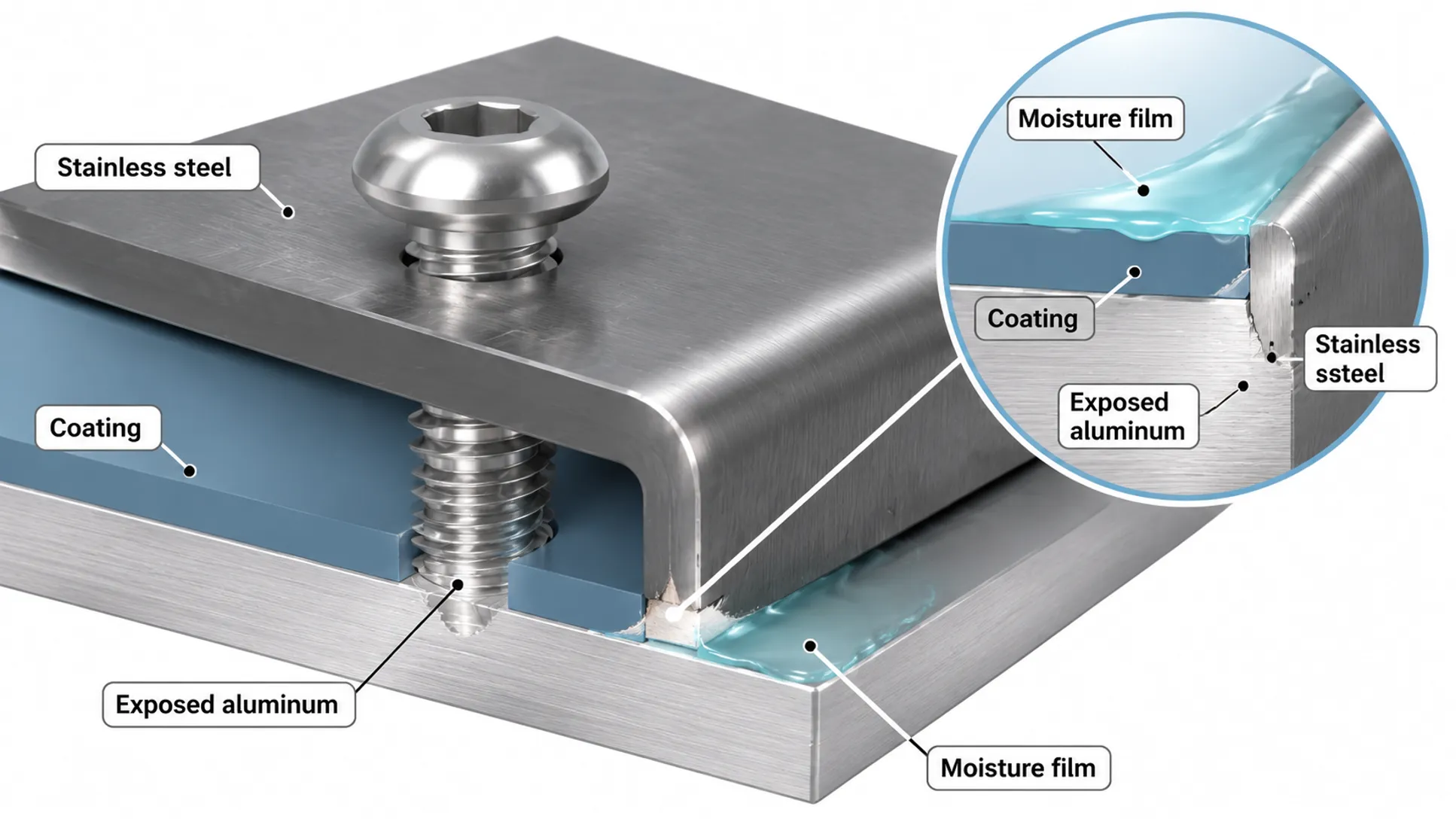
Depending on the assembly, the designer may specify protection on the stainless contact zone, both surfaces, or a separate insulating barrier. The extent and type of protection depend on exposure; a universal coating width or thickness cannot be selected from the material names.
Sealant and drainage also need coordinated details. Excluding moisture from an interface can help, but an incomplete seal may leave a path into a concealed wet area. Check that specified seals do not obstruct drainage openings.
Review the assembled orientation, including low points and horizontal ledges. You should be able to identify a route for incidental water to leave and a practical means of checking that the route remains open.
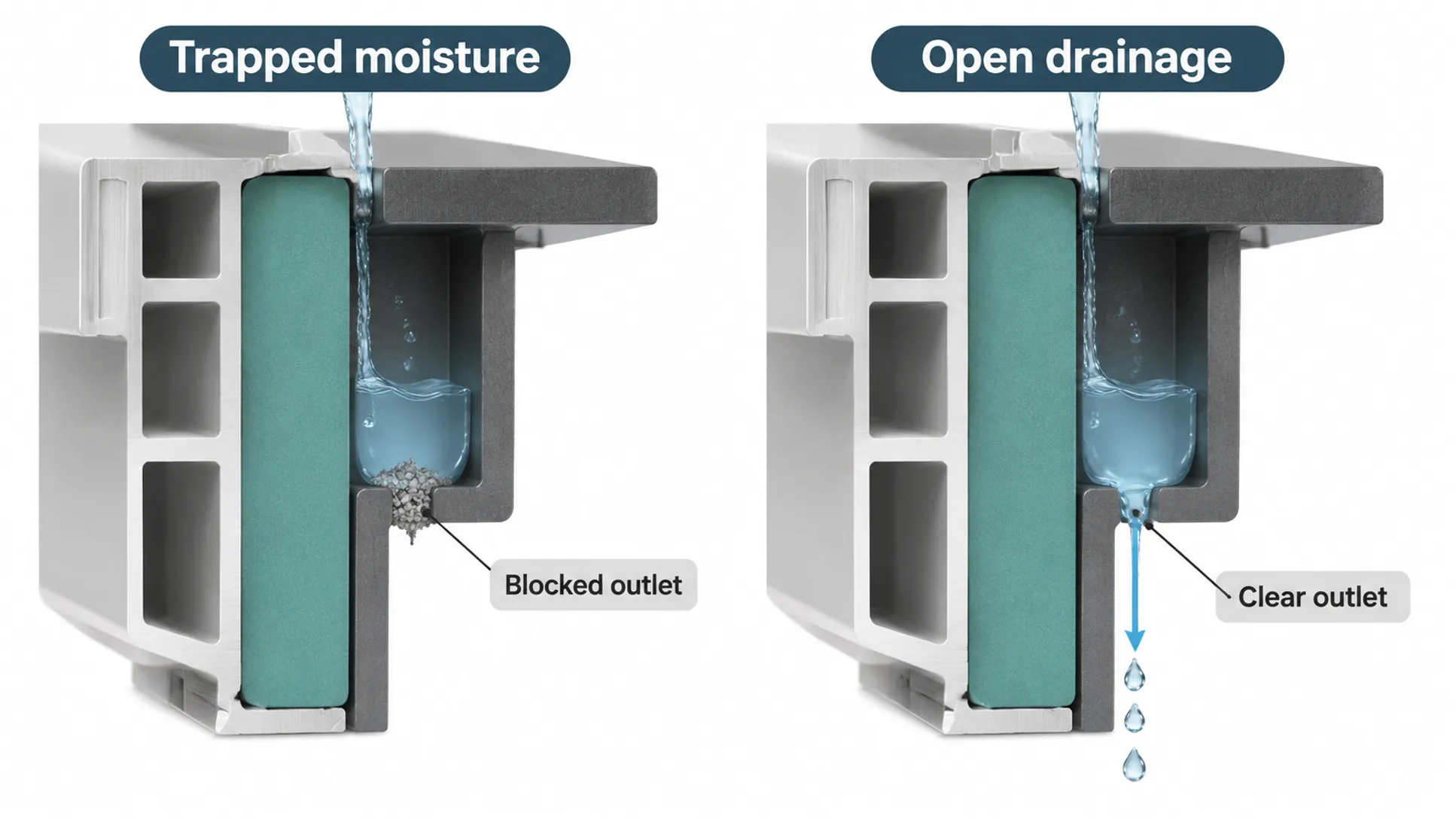
For architectural aluminum profiles, include the final installation orientation in the review. For industrial aluminum profiles, include washdown conditions and access around brackets or enclosed frame sections.
Document the Joint Before Procurement
Send the supplier a connection detail alongside the extrusion drawing. A request for “corrosion-resistant aluminum with stainless bolts” leaves the important interfaces undefined.
| Review Item | What to Record | What to Confirm |
|---|---|---|
| Service exposure | Indoor, outdoor, coastal, washdown or immersed | Wetting, salts and drying conditions |
| Materials | Aluminum alloy, temper and stainless grade | Suitability of each material for its duty |
| Contact geometry | Bracket, hole, shank and thread interfaces | All conductive paths and exposed areas |
| Isolation | Barrier, washer and sleeve arrangement | Mechanical suitability and continuity of separation |
| Surface protection | Finish, machining order and repair plan | Coverage at holes, cut edges and contact faces |
| Moisture control | Seal locations and drainage openings | Water exclusion, discharge and inspection access |
| Assembly verification | Inspection points and acceptance criteria | Correct parts, intact barriers and open drains |
Separate responsibilities for extrusion manufacture, fastener supply, installation and design approval. This prevents a profile finish specification from being mistaken for approval of the complete connection system.
For broader material selection, see the aluminum versus stainless steel profile guide. For an extrusion enquiry, contact Yoverd Aluminium with your profile drawing, required finish and relevant connection requirements.
Inspect the Connection During Service
Make the joint accessible where practical. Inspect for damaged barriers, coating blisters, deposits near fasteners, retained dirt and blocked drains. FAA guidance identifies aluminum corrosion products as white-to-gray material, but appearance alone does not establish the mechanism or remaining strength.
When you find suspicious deposits, document their location and check the surrounding interface. Distinguish galvanic attack from other possible causes, such as crevice corrosion or surface contamination, before deciding on a repair.
Set inspection intervals to suit exposure, accessibility and the consequences of failure. For a load-bearing connection with pitting, material loss or looseness, seek assessment by the responsible engineer. Cleaning away visible products does not verify that the joint remains fit for service.
Frequently Asked Questions
Can Stainless Steel Screws Be Used in Aluminum Outdoors?
Yes, if the complete joint is suitable for its exposure. Review conductive contact, moisture, surface protection and installation damage. A small stainless fastener is generally a more favourable area arrangement than a broad stainless plate, but it is not a guarantee against local corrosion.
Does 316 Stainless Steel Stop Aluminum Galvanic Corrosion?
No. The stainless grade must suit its own environment, but changing the grade does not break the electrical path or exclude moisture. You still need to assess the aluminum interface, exposed areas and specified protection measures.
Does Anodizing Fully Isolate an Aluminum Connection?
Do not assume so. Machining, holes, threads or service damage can leave conductive paths or exposed metal. Review the finished assembly and use a separately specified isolation arrangement where the design requires it.
Is a Dry Joint Still at Risk of Galvanic Corrosion?
Galvanic corrosion requires an electrolyte. An initially dry joint may later encounter condensation, rain or washdown. Specify protection for the expected service conditions, including concealed areas that can remain wet after exposed surfaces have dried.
Final Thoughts
You can reduce galvanic corrosion risk by reviewing the complete wet connection: metal areas, conductive paths, isolation, coating damage and drainage. Include those details when specifying your aluminum profiles, and have the responsible designer confirm the assembly for its service conditions.