

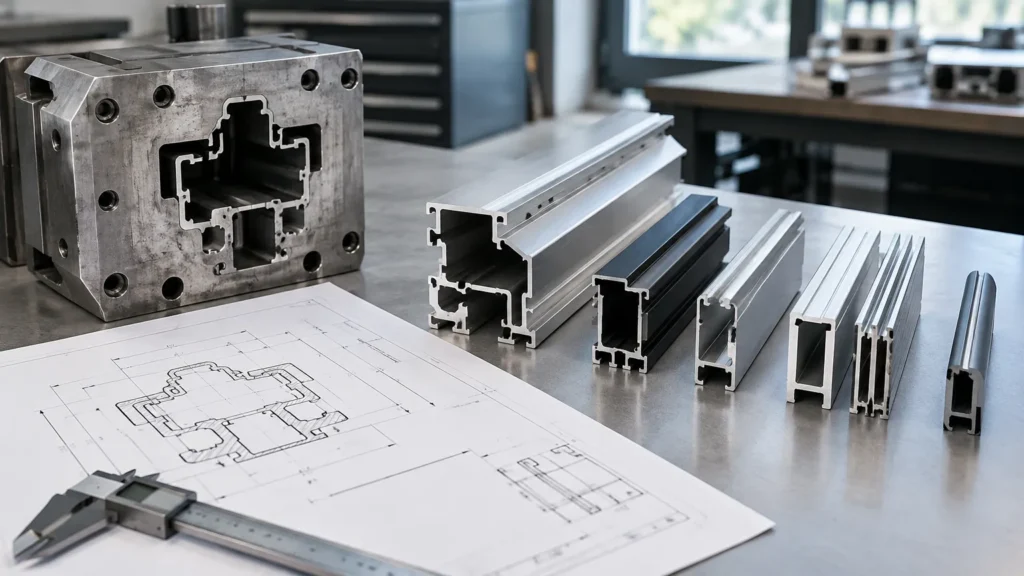
Custom aluminum extrusion is useful because it removes the compromise of forcing a standard profile into a product that needs a different cross-section. But that flexibility creates a chain of decisions: die design, minimum order quantity, trial sample, tolerance, finish, secondary processing, inspection and delivery.
There is no universal MOQ, die cost or lead time for a custom profile. A simple solid section in a common alloy and mill finish is a different project from a thin-walled hollow profile with tight tolerances, anodizing and CNC machining. This guide explains what drives those numbers and what information to send when you request a quote.
What “Custom” Means in Extrusion
A custom aluminum extrusion is a profile produced from a die made for your specific cross-section. The die defines the outside shape, internal voids, wall thickness, ribs, slots and other features that would be difficult or impossible to assemble from standard bars, tubes or sheets.
The Aluminum Extruders Council (AEC) describes an extrusion die as a steel disk, normally H13, with an opening that matches the intended cross-section of the finished product. Dies are broadly grouped into solid or flat dies for solid shapes and hollow dies for hollow or semi-hollow shapes. Hollow dies can include bridge, porthole and spider designs, and a single die may combine solid, semi-hollow and hollow features.
That distinction matters because it changes both tooling cost and production risk:
| Profile type | What it may include | Why it affects cost and lead time |
|---|---|---|
| Solid profile | Solid shape, ribs, slots, angled faces, multiple apertures | Tooling is usually simpler, but thin walls, tight tolerances and unbalanced sections still increase difficulty |
| Semi-hollow profile | A partially enclosed void or deep narrow tongue | Die tongues can be fragile; wall balance and tongue ratio become critical |
| Hollow profile | Enclosed voids, round or rectangular tubes, complex internal channels | Requires mandrels or other hollow-die tooling; wall thickness and weld-seam control become more important |
| Multi-hole die | Several identical sections extruded in one cycle | Can improve output, but requires die balance and sufficient press capacity |
Yoverd’s custom aluminum extrusion profiles page summarizes the production route as: send drawings or samples, complete design review and quotation, approve the mold and sample, move to mass production, then package and distribute globally. The page also lists 6000-series material, customized profile length, customized wall thickness and a dimensional tolerance of ±0.1 mm or as required. Those values should still be confirmed against the drawing, alloy and application.
If you need more background on how a billet becomes a finished profile, read the guide to the aluminum extrusion process.
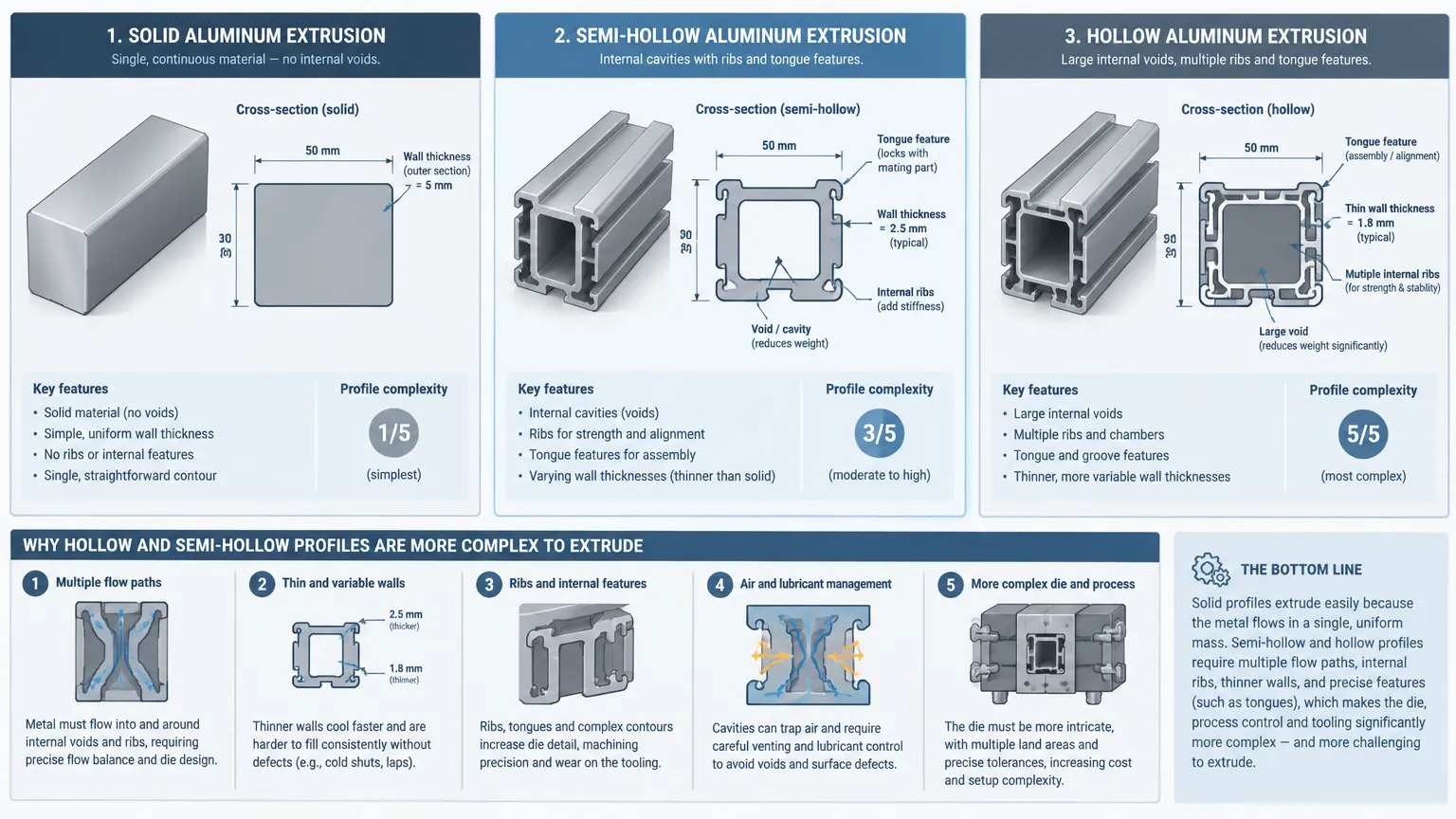
Video: Beyond Bars, Ts and Angles: Designing Aluminum Extrusions — an AEC webinar on custom profile design, alloy selection, geometry and tolerancing.
Die Types and Tooling Cost Drivers
A custom die is not a single catalogue item. Its cost depends on how much steel is needed, how complex the section is, how many correction cycles are expected and how long the tool must run.
AEC notes that die manufacturing methods and costs vary widely, and that the choice depends on the profile, press and container size, and production requirements. The main cost drivers are:
- Cross-section size. AEC uses circumscribing circle diameter (CCD), the smallest circle that encloses the profile, as one measure of extrusion economics. Larger sections need larger tooling and suitable press capacity.
- Weight per unit length. AEC identifies weight per foot as a factor in profitable press operation. Very heavy sections consume press capacity quickly, while very light sections may require more metres to reach an economical production run.
- Wall thickness and balance. Thin walls, abrupt thickness changes and unbalanced metal flow make die correction more difficult.
- Hollow and semi-hollow features. Mandrels, bridges and narrow tongues add tooling complexity and can increase trial time.
- Tolerances. AEC explains that extrusions can be produced to industry-standard or precision tolerances, and that complex components may require geometric dimensioning and tolerancing. Tighter tolerances can require more die correction, slower extrusion or additional machining.
- Number of holes or cavities. Multi-hole dies can improve output, but only if the sections can be balanced and the press has sufficient capacity.
- Expected tool life and order volume. A die used for a long production program may be designed differently from a die used only for a prototype.
- Trial and correction work. First samples often require adjustment before the profile meets the drawing.
When you receive a tooling quotation, ask what is included:
- Die design and manufacture
- Die trial and first sample
- Correction rounds
- Sample delivery
- Die ownership
- Storage, maintenance and repair responsibility
- Conditions for replacing the die
- Cost and lead time for design revisions
Without those terms, two tooling quotations that look similar may carry very different commercial risks.
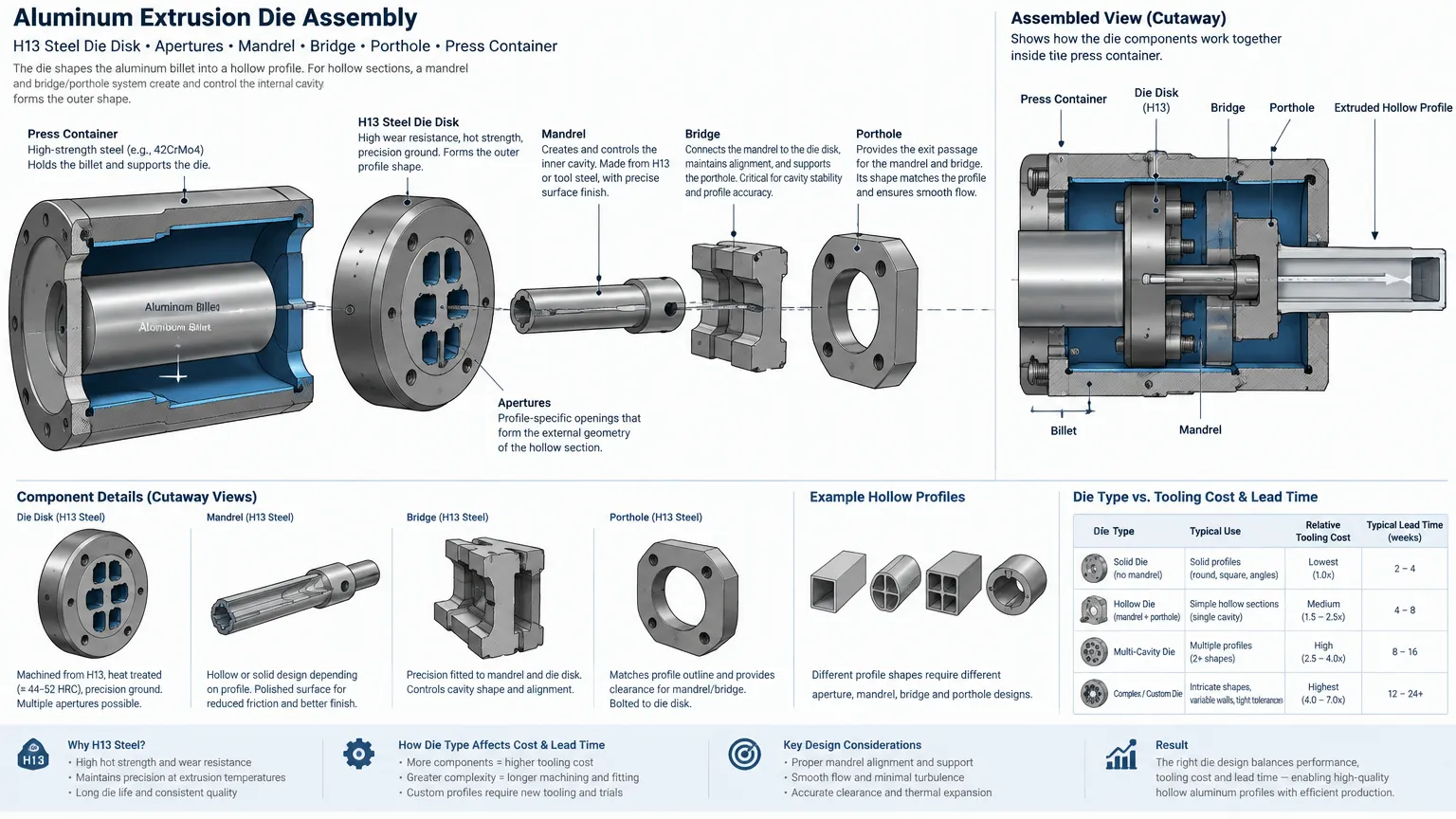
Video: Introduction to Extrusion Dies — an AEC webinar explaining die design, metal flow and what makes a section easy or difficult to extrude.
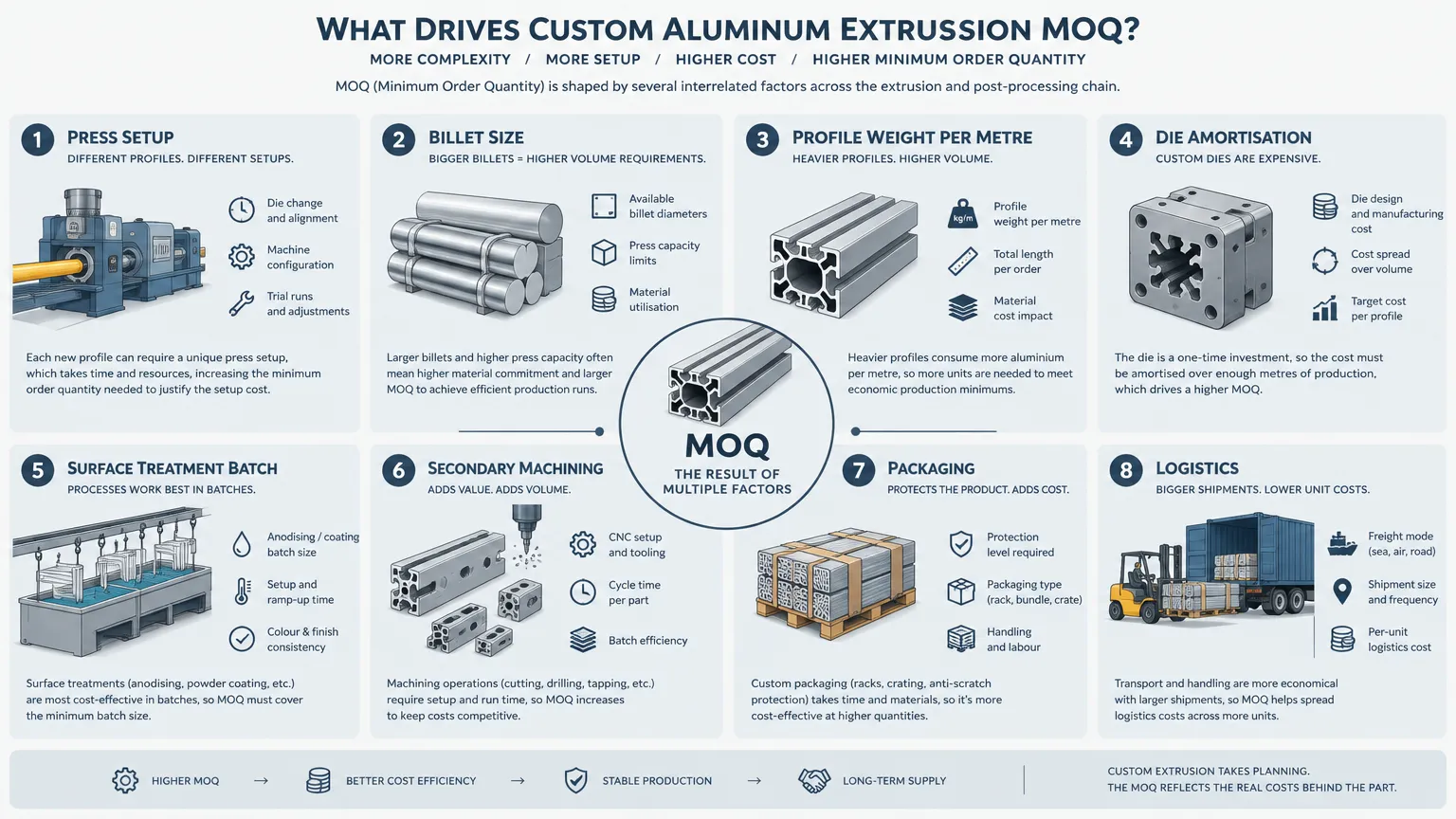
MOQ: What Drives the Minimum
MOQ is usually a commercial and production-economics decision, not a fixed property of aluminum. The same profile may have a different minimum at different suppliers because their presses, billet sizes, finishing lines, order books and inventory policies differ.
The most common MOQ drivers are:
- Press setup and billet economics. Each production run consumes press time, setup labour and material. A minimum quantity helps make that setup economical.
- Profile weight per metre. A heavy profile reaches a commercially viable weight with fewer metres than a light profile. This is one reason a small cross-section can have a higher metre-based MOQ.
- Die amortisation. If the supplier or buyer amortises tooling into the piece price, order volume affects how the cost is recovered.
- Surface treatment batch size. Anodizing, powder coating, PVDF, electrophoresis, wood-grain transfer and polishing may have their own batch, colour or line minimums.
- Secondary operations. CNC machining, drilling, punching, bending, welding or assembly each add setup time and inspection work.
- Packaging and logistics. Bundle size, container loading, protective packaging and destination can affect the smallest practical order.
- Alloy and temper availability. Common alloys and tempers are easier to schedule than special material requirements.
- Forecast repeatability. A profile with a predictable annual forecast is easier to plan than a one-off section with uncertain repeat demand.
Yoverd’s custom extrusion page describes flexible MOQs, but the exact minimum still depends on the profile, finish, processing and order plan. Do not compare MOQs without also comparing what is included in the quotation.
If your expected quantity is low, ask the supplier whether any of these options are feasible:
- Use an existing or similar die, if one is available
- Simplify the cross-section
- Choose a common alloy and finish
- Reduce the number of secondary operations
- Combine several parts into one profile
- Approve a sample first and then schedule a production batch
- Accept a higher unit price for a smaller trial quantity
- Plan a repeat order instead of treating the project as one-off
None of these options is automatic. The supplier still needs to review the drawing and production route.
Lead Time Breakdown: Tooling, Trial and Production
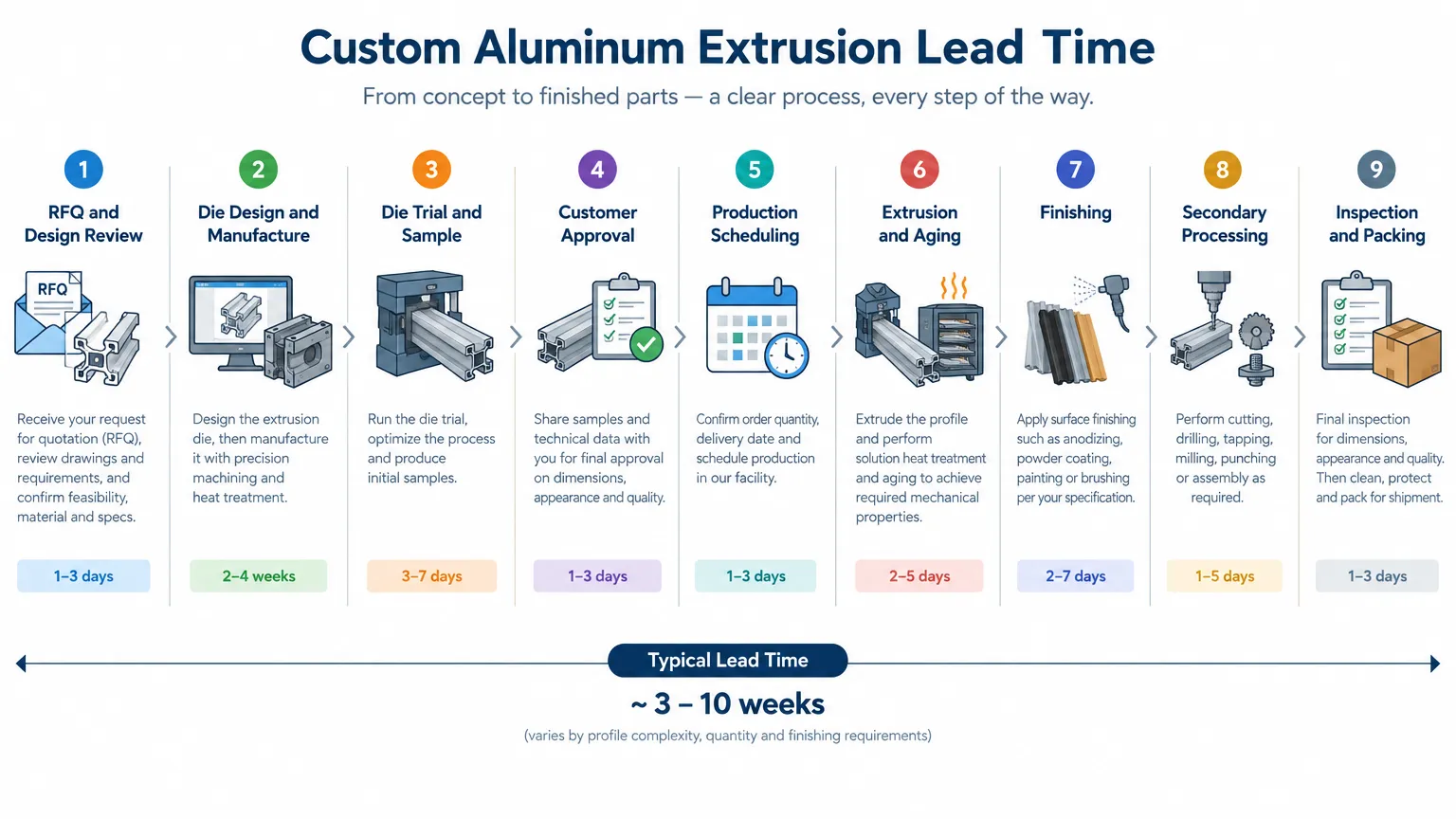
Lead time for a new custom profile is not one number. It is a sequence of technical and commercial steps, each of which can be delayed by missing information.
| Stage | What happens | Common delay causes |
|---|---|---|
| RFQ and design review | Supplier checks die feasibility, alloy, tolerance, finish, machining and quantity | Missing drawing, unclear tolerance, undefined finish or incomplete quantity plan |
| Die design and manufacture | Tooling is designed, machined and prepared for trial | Complex hollow section, large CCD, tight tolerance or special tool steel |
| Die trial and sample | First profile is extruded and checked against the drawing | Die correction, wall imbalance, twist, surface or dimensional adjustment |
| Customer approval | Buyer reviews sample, dimensions, finish and assembly fit | Late inspection, unclear acceptance criteria or drawing revisions |
| Production scheduling | Approved die is allocated to a press and billet schedule | Press capacity, alloy availability and existing production plan |
| Extrusion and aging | Profile is extruded, quenched, stretched, cut and aged as required | Alloy, section complexity and required mechanical properties |
| Finishing | Anodizing, powder coating, PVDF, polishing or other treatment is applied | Colour approval, coating batch, special finish or subcontracting |
| Secondary processing | Cutting, drilling, punching, CNC machining, bending or assembly | Machining program, fixture, tolerance and inspection plan |
| Inspection and packing | Dimensional and documentation checks are completed before shipment | Unclear inspection standard, missing documents or special packaging |
AEC’s process overview explains that after the profile shape and alloy are selected, an extrusion die and associated tooling are produced. The billet and tools are preheated, the softened billet is forced through the die, and the formed profile may then be quenched, mechanically treated and aged before finishing, fabrication or packing. Those process steps explain why tooling, trial, production and finishing must all be included in the schedule.
For customized industrial aluminum profiles, Yoverd’s custom aluminum extrusion profiles for industrial applications page lists tooling development and sample production at 7–15 days, depending on profile complexity and surface requirements, and a typical lead time of 20–30 days. Treat those figures as the page’s reference range for that product group, not as a commitment for every drawing. Confirm the schedule after the supplier has reviewed the section, finish, machining, quantity and inspection requirements.
Also separate three terms:
- Tooling and sample lead time: time to make the die and produce an approval sample.
- Production lead time: time from approved sample or production release to finished goods.
- Door-to-door delivery time: production lead time plus inspection, documentation, customs and transport.
A supplier can control some of these stages, but not all of them.
Information Needed for an Accurate Quote
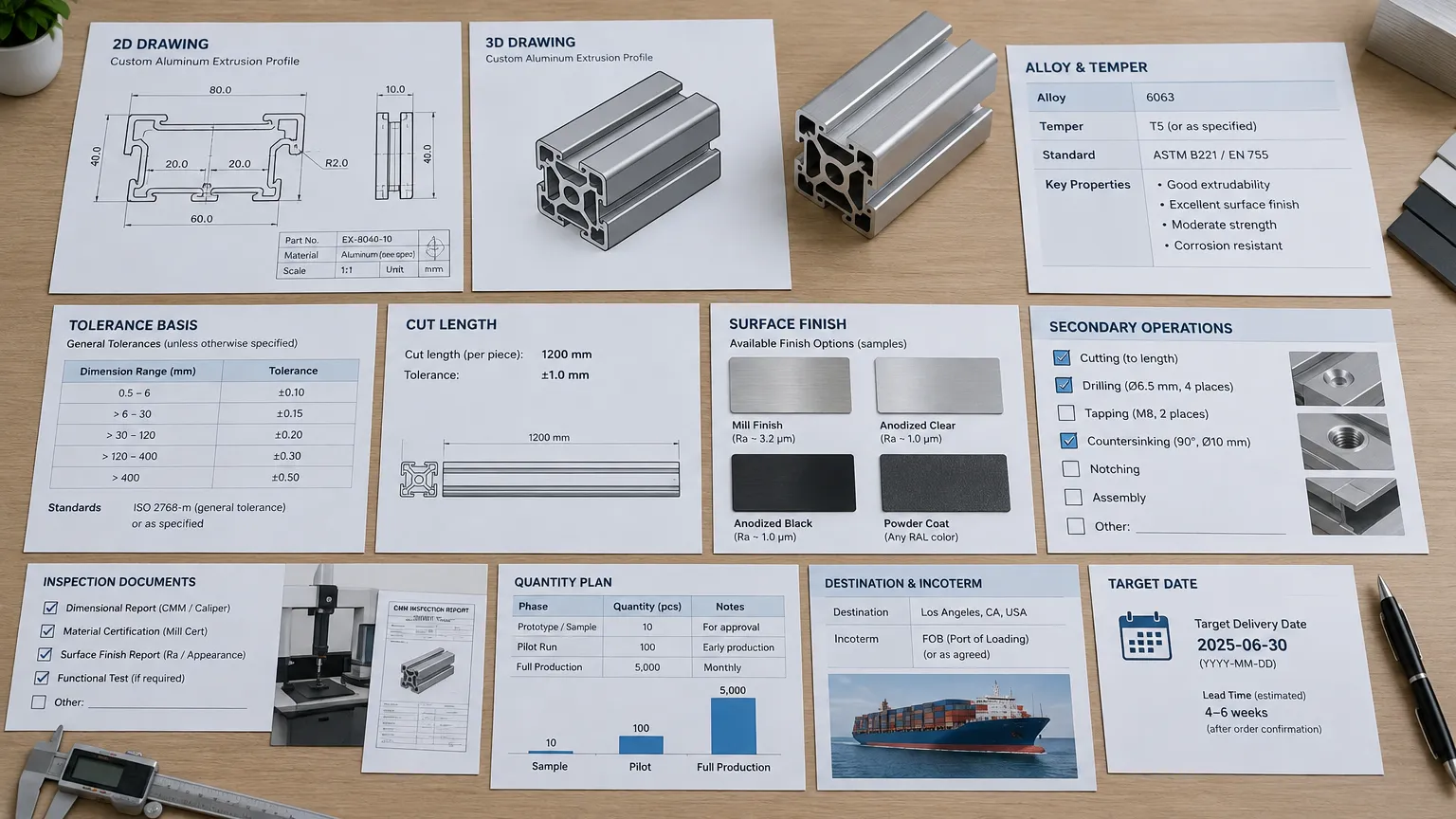
A useful quote starts with a complete requirement. The more the supplier has to assume, the wider the gap between the first quotation and the final price.
Send the following information:
| Information | Why it matters |
|---|---|
| 2D and 3D drawings | Defines the cross-section, critical dimensions, radii, voids and machining reference surfaces |
| Alloy and temper | Affects strength, extrudability, finish, weldability and heat treatment |
| Governing standard | Defines whether ASTM, EN, ISO, GB or a customer specification applies |
| Tolerance basis | Separates standard, precision and project-specific tolerances; names the critical dimensions |
| Cut length and length tolerance | Affects yield, packaging and secondary processing |
| Surface finish | Mill finish, anodizing, powder coating, PVDF, polishing or another treatment changes cost and schedule |
| Colour or appearance requirement | Visible architectural parts need clearer colour and defect criteria than hidden industrial parts |
| Secondary operations | Cutting, drilling, punching, CNC machining, bending, welding or assembly add setup and inspection |
| Inspection documents | Material certificate, dimensional report, first-article inspection or other records should be named in advance |
| Quantity plan | Trial sample, first order, repeat quantity and annual forecast affect MOQ and unit cost |
| Destination and Incoterm | Determines packing, transport responsibility and documentation |
| Target date | Helps the supplier separate a feasible schedule from an aspirational one |
| Existing sample or die number | May reduce development time if a similar or existing tool can be used |
AEC’s design guidance highlights why the technical package matters: CCD, weight per unit length, wall balance, symmetry and press availability all affect extrusion economics. A buyer who sends only a picture of a profile has not yet supplied enough information for a reliable quotation.
For a broader supplier qualification process, see the guide on how to choose an aluminum extrusion supplier.
Trial Samples and Approval Process
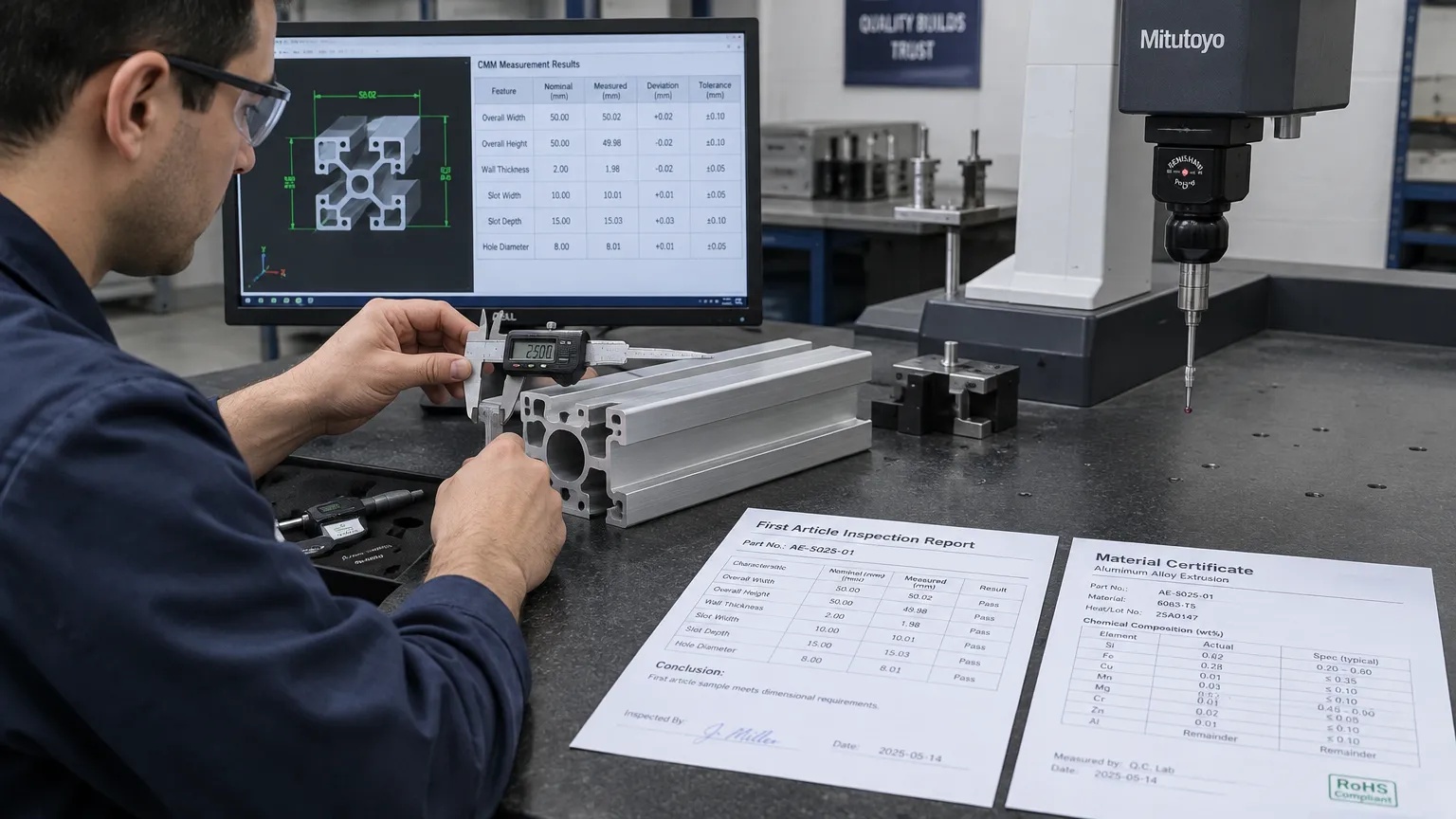
A trial sample is not a formality. It is the point where the drawing, die, alloy, finish and inspection method are tested together.
Ask which type of sample you will receive:
- Die trial sample: proves that the profile can be extruded, but may not yet show the final surface or machining.
- Finished surface sample: shows colour, gloss, texture, anodizing or coating appearance.
- Machined first article: shows the profile after cutting, drilling, tapping, milling or other secondary operations.
- Assembly sample: confirms fit with mating parts, seals, fasteners or panels.
Before approval, define the acceptance criteria:
- Critical dimensions and tolerance limits
- Straightness, twist, flatness and wall variation
- Surface defects allowed or not allowed
- Colour and gloss range, if a finish is applied
- Material certificate or test report, if required
- First-article inspection report and measuring method
- Packaging requirements for production
Keep the approval in writing and tie it to a drawing revision number. If the sample requires changes, record whether the change is a die correction, a drawing revision or a new machining operation. Each path can have a different cost and lead time.
Yoverd’s quality control page describes the company’s quality and certification approach, but certificate scope, product applicability and inspection documents should still be confirmed for each order.
Cost Optimisation Tips
The best cost reduction usually happens before the die is cut.
Design for extrusion
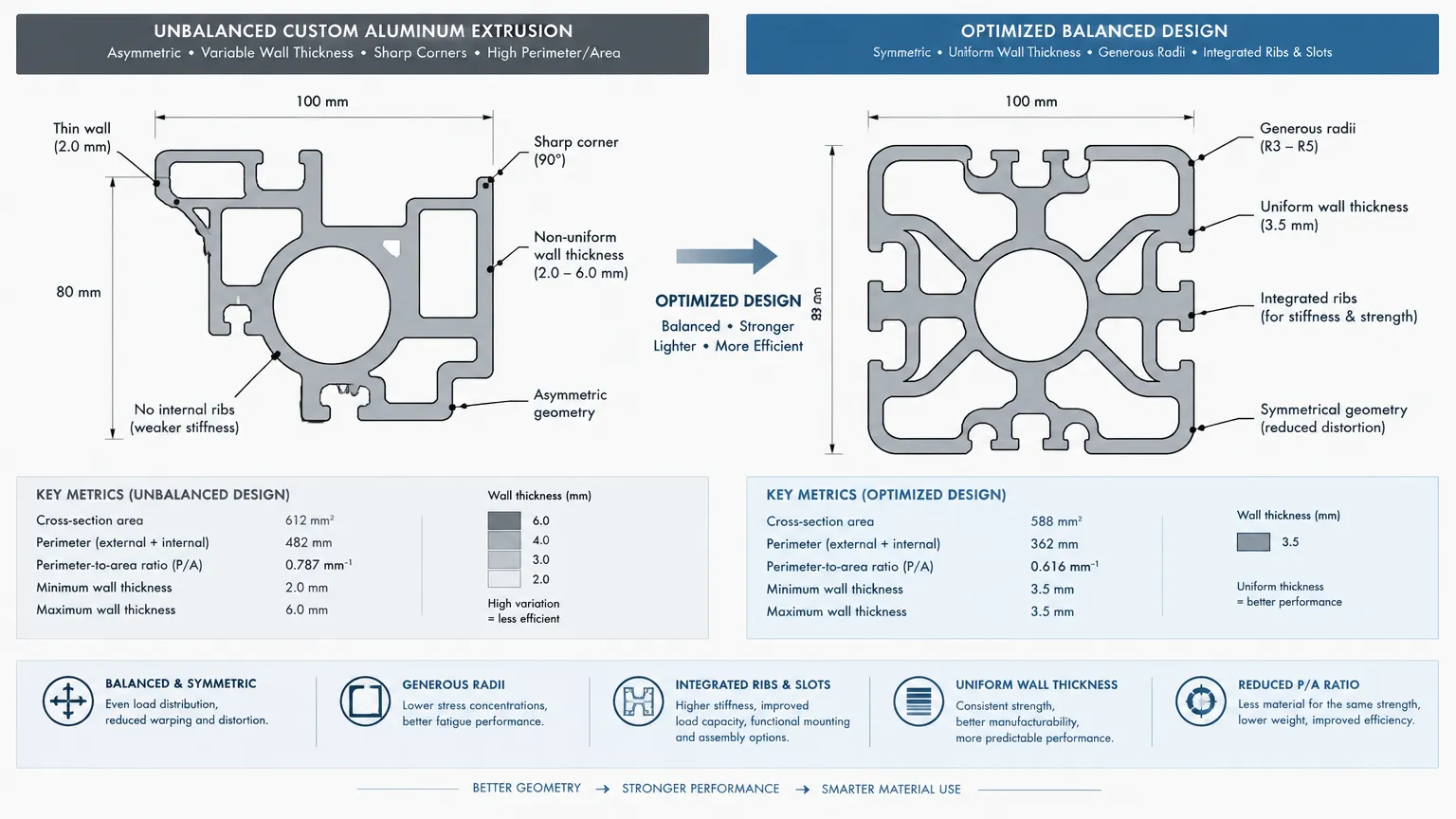
AEC’s design recommendations include balanced walls, minimising hollows where possible, generous tapers, symmetry, using grooves, webs and ribs, and minimising the perimeter-to-cross-section ratio. Avoid deep, narrow tongues because they create fragile die features and increase correction risk.
Practical design checks include:
- Keep wall thickness as uniform as the function allows
- Use generous radii instead of sharp internal corners
- Avoid unnecessary tight tolerances on non-critical faces
- Place critical dimensions where they can be measured consistently
- Reduce the number of separate parts by integrating slots, ribs, mounting features or channels
- Check whether one profile can replace an assembly
Choose the right specification, not the tightest one
Tighter tolerances, special alloys and premium finishes all have their place, but they should be limited to dimensions and surfaces that affect function or appearance. Applying the tightest possible tolerance to every face increases die correction, machining and inspection cost without improving the product.
Plan the commercial route
- Use a common alloy and temper where performance allows
- Standardise finish colours across parts
- Reduce secondary operations where possible
- Combine shipments or schedule production with realistic repeat demand
- Clarify tooling ownership and reuse before the first order
- Approve samples quickly but against clear criteria
Video: Creating Cost-Effective Extruded Aluminum Product Solutions — an AEC webinar on the cost structure of extruded aluminum components and cost-optimised design decisions.
FAQ
What is the MOQ for custom aluminum extrusion?
There is no universal MOQ. It depends on profile weight, press economics, die amortisation, finish batch size, secondary processing, packaging, logistics and repeat forecast. Yoverd’s custom extrusion page describes flexible MOQs, but the exact minimum must be confirmed against the drawing and order plan.
How much does a custom extrusion die cost?
There is no reliable universal die price. Cost is driven by section size, solid or hollow construction, wall thickness, tolerance, number of cavities, expected tool life, correction work and sample requirements. Ask for an itemised tooling quotation that includes design, trial, correction, ownership, storage and repair terms.
How long does custom aluminum extrusion take?
Lead time has several stages: design review, die manufacture, trial sample, customer approval, production, finishing, secondary processing, inspection and packing. Yoverd’s industrial custom profiles page lists 7–15 days for tooling and sample production and typically 20–30 days lead time, but the actual schedule must be confirmed after the drawing is reviewed.
What should I send to get a quote?
Send 2D and 3D drawings, alloy and temper, governing standard, tolerance basis, cut length, finish, secondary operations, inspection documents, quantity plan, destination, Incoterm and target date. If you have an existing sample or die number, include that as well.
Can I order a sample before bulk production?
Yes, in many custom extrusion projects a sample or trial run is used to verify dimensions, finish and assembly fit before production. Confirm what type of sample will be supplied, which measurements will be reported and how approval will be recorded.
Get the Specification Right Before You Ask for Numbers
The fastest way to reduce MOQ, tooling risk and lead time is to send a complete technical package. A clear drawing, alloy, tolerance basis, finish, processing requirement, inspection standard and quantity plan allows the supplier to quote the product you actually need.
Review Yoverd’s custom aluminum extrusion capability, browse the aluminum extrusion catalog, or contact Yoverd Aluminium with your drawing and project requirements for a technical review and quotation.