
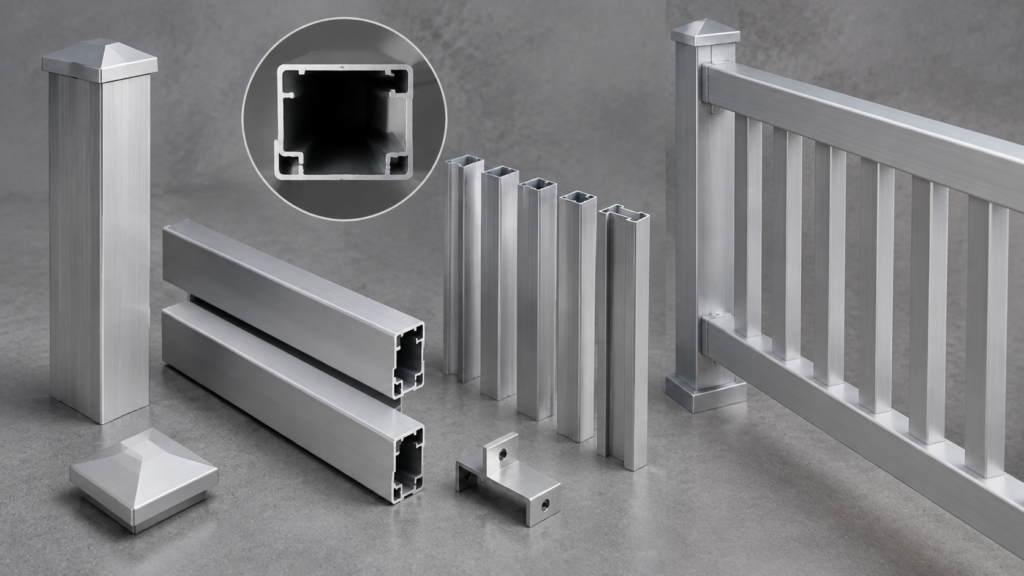
An aluminum fence may look like a simple row of posts and panels, but the profiles inside the system determine how the fence assembles, how it performs, and how much freedom a distributor or fabricator has at installation. Wikipedia’s overview of aluminum fencing describes the category as lightweight, corrosion resistant, easy to clean, and available in many preformed styles. Those are useful general advantages. They are not a complete purchase specification.
For a B2B buyer, the important question is not simply “how much does an aluminum fence cost?” It is whether the proposed profile set has the correct alloy, temper, wall thickness, tolerances, finish, hardware, and inspection plan for the intended market and project. Two suppliers can both quote a black three-rail aluminum fence while offering different sections, coating systems, and assembly methods. The profiles may look similar after coating but behave differently in handling, wind exposure, gate operation, and long-term maintenance.
This guide explains the profile decisions a distributor, importer, fence manufacturer, or fabricator should review before placing an order. It focuses on extruded aluminum fence profiles rather than installation pricing or consumer comparison shopping.
What an Aluminum Fence Profile System Includes
An aluminum fence is a system, not a single extrusion. The exact bill of materials varies by design, but most fence lines combine several profile families and accessory parts.
| Component | What it does | What the buyer should specify |
|---|---|---|
| Posts | Carry panel loads, resist bending, and anchor the fence line or gate | Section shape, outside dimensions, wall thickness, cap or plug, base or mounting detail, and gate-post requirements |
| Top and bottom rails | Hold pickets in position and control panel stiffness | Rout or punch pattern, hole pitch, end detail, screw boss, wall thickness, and racking provision |
| Pickets or balusters | Create the visual infill and define security or ornamental style | Hollow or solid section, picket spacing, end treatment, thickness, and fastening method |
| Caps, plugs, and finials | Close exposed ends, improve appearance, and help manage water | Fit, retention method, drainage, material compatibility, and finish |
| Brackets and hardware | Connect panels, gates, posts, and infill | Load capacity, hole pattern, fastener material, adjustment, and corrosion protection |
| Gate frame profiles | Form an operating assembly that must resist repeated movement | Corner joints, bracing, hinge and latch reinforcement, diagonal stiffness, and sag control |
The customer may ask for a “3-rail black aluminum fence” or an “ornamental aluminum fence.” A fabricator still needs the profile drawing, cut list, hole positions, and hardware details behind that description. A profile set that works for a light residential boundary may not be appropriate for a commercial perimeter, a pool enclosure, or a wide driveway gate.
Choose the Alloy and Temper Before the Finish
Most aluminum fence profiles are made from 6xxx-series aluminum because this family offers a practical balance of strength, corrosion resistance, weldability, machinability, and surface finish. The Aluminum Extruders Council explains that 6063 is commonly selected for building products where very high strength is not the primary requirement, while higher-strength alloys such as 6061 or 6082 may be considered for more demanding structural parts.
Alloy alone is not enough. Temper describes the heat treatment or mechanical condition that helps determine the final mechanical properties. The AEC alloy and temper guide defines 6063-T5 as material cooled from an elevated temperature and then artificially aged. T6 is solution heat-treated and artificially aged, so it can offer higher specified properties, but it is not automatically the better choice for every fence line. Availability, section geometry, forming, welding, finish quality, tolerance, and cost all matter.
| Common route | Where it may fit | Procurement note |
|---|---|---|
| 6063-T5 | General architectural and fence profiles, including many visible rails, posts, and pickets | A common baseline for extrusions with good surface quality; confirm the section and wall thickness for the actual load |
| 6063-T6 | Projects that need higher specified properties from a familiar 6xxx alloy | Confirm availability, forming requirements, welding strategy, and whether the profile geometry already provides enough stiffness |
| 6061-T6 or 6082-T6 | Components where a higher-strength alloy is justified by the design | Higher strength can change extrusion difficulty, tolerance, finish, joining, and cost; use it for a defined reason, not by default |
A responsible purchase order identifies the alloy, temper, governing material standard, and traceability requirement. It should not say only “aluminum” or “6063” without the temper. Welding or post-processing can also change local properties, so the joint design and finishing sequence should be reviewed together rather than assumed.
Structural performance is not established by the alloy name alone. Post height, span, wind load, panel solidity, gate weight, anchor condition, and connection design all affect the result. For a structural or safety-critical application, the section must be checked by a qualified engineer under the applicable building requirements. The supplier can manufacture to the approved drawing; it should not replace the project engineer’s design responsibility.
Specify the Geometry and Tolerances
Aluminum extrusions can create complex shapes, but the die does not remove the need for good design rules. The AEC design guidance recommends balanced wall thicknesses, practical tongue ratios, and attention to the relationship between profile size, weight, press capability, and cost. A highly unbalanced section can be harder to extrude, harder to hold within tolerance, and more likely to create finishing problems.
For fence profiles, the drawing should define the features that control assembly and appearance. Typical examples include:
- Outside dimensions of the post, rail, and picket.
- Nominal wall thickness and, where important, the minimum wall permitted at a defined measuring point.
- Inside clearance for the picket or reinforcing insert.
- Screw boss diameter, pilot detail, and fastener engagement.
- Hole diameter, pitch, position, and edge distance.
- Rail web height, return legs, ribs, and open channels.
- Picket spacing, panel width, and end clearances.
- Cut length, end squareness, machining allowance, and visible face.
Not every dimension needs a tight tolerance. Over-tolerancing raises cost and can create unnecessary rejections. The AEC tolerance overview explains the difference between accepted industry-standard tolerances and tighter precision tolerances, with detailed tables published in Aluminum Standards & Data. Buyers should identify the critical-to-function dimensions, then let the extruder confirm what is practical for the selected alloy and section.
Straightness, twist, and flatness deserve special attention for fence rails and gate frames. A small deviation may be invisible in a short sample but become obvious when thousands of parts are assembled into long panels. Punch position and hole size also control how the panel racks or follows a slope. Some aluminum fence panels are designed to rack, but the available range depends on the rail opening, hole geometry, and picket section. Do not promise a universal racking range without validating the actual profile set.
Match the Panel Style to the Market
Aluminum fence profiles can support many commercial styles. Common choices include two-rail and three-rail systems, flat-top or spear-top pickets, pressed pickets, ornamental infill, privacy slats, and heavier commercial sections. The profile design should match the channel in which the product will be sold.
For decorative or residential distribution, appearance and repeatable assembly often lead the specification. Picket spacing, repeat pattern, cap style, and color consistency become important. For a product page or dealer program, review the available aluminum railing profiles and vertical picket railing profiles as part of one visual and mechanical system.
For commercial or public infrastructure, load and durability requirements usually become more demanding. Posts, rails, brackets, anchors, and gate hardware may need heavier sections or additional reinforcement. Appearance still matters, but the profile should not be selected from a catalog image alone.
Privacy fence and screen systems add more solid area. A screen blocks wind, but it also increases the load transferred to posts and rails. Slat spacing, drainage, expansion, and the method used to retain infill all need review. An architectural aluminum slat railing system may use different profiles from a traditional picket fence, even when the finished appearance seems similar.
Pool, security, and child-safety fencing requires special care. Opening dimensions, climbability, gate self-closing or self-latching requirements, and accessible-hardware rules vary by jurisdiction and project. The profile supplier can document dimensions and tolerances, but the buyer or project team must confirm compliance with the applicable local code.
Gates deserve their own structural review. A gate is not just a fence panel with hinges added. Its frame must resist racking and repeated operation, and the gate posts must carry the additional load. A design that works for a narrow garden gate may need a different profile, brace, hinge, or post arrangement when the opening becomes wider.
Choose a Finish That Matches the Specification
Powder coating is one common route for aluminum fence profiles because it can provide a controlled color, gloss, and texture. A colored surface, however, is not a complete performance specification.
For exterior use, the buyer should define the applicable industry or project coating standard, performance class, pretreatment, resin system, film thickness, cure, color, gloss, adhesion, impact, and weathering tests. A generic RAL or custom color reference controls appearance, not durability. Ask the coater to confirm the exact system and test plan.
Anodizing is another option. It converts the aluminum surface into an aluminum oxide layer integrated with the base metal. AEC’s finishing overview notes that aluminum naturally forms a protective oxide film and that anodizing or painting can be used when additional protection or appearance is required. Anodized fence profiles can offer a metallic clear, bronze, or dark appearance and good surface hardness, but color choice is narrower than powder coating and scratched or chemically attacked surfaces are difficult to disguise.
Surface quality before coating is critical. Die lines, pickup, streaking, scratches, and inconsistent pretreatment can become more visible after finishing and may affect adhesion or appearance. The extrusion supplier and coater should agree on visible-surface requirements, sample approval, handling protection, and the disposition of minor defects. Small finish defects should not be hidden under the word “commercial” unless the buyer and supplier have defined that term.
Check Environmental, Structural, and Maintenance Requirements
Aluminum’s low density and natural oxide layer make it attractive for fence and railing structures, but it is not immune to every environment. Chlorides, persistent moisture, industrial pollutants, and certain cleaning chemicals can affect the surface. Coating selection, pretreatment, drainage, and maintenance instructions should reflect the actual exposure.
Mixed-metal assemblies need design review. Corrosion behavior depends on the combination of metals, coatings, fasteners, drainage, moisture, and pollutants in contact. Fasteners, hinges, brackets, and anchors should be selected as one system; a supplier should not assume that a well-coated extrusion remains immune when the surrounding assembly creates an aggressive service condition.
Cleaning requirements should be supplied with the product. In general, mild, pH-neutral cleaning methods and prompt removal of aggressive deposits are safer than acid or alkaline cleaners, but the finish supplier’s written instructions take priority. Abrasive pads and strong solvents can damage both powder coating and anodizing.
Sustainability can also be part of the commercial case. The International Aluminium Institute reports that recycling aluminum saves about 95% of the energy required for primary production. Recycled content, alloy control, and traceability still need to be documented; a sustainability claim should not replace the material specification.
Control Quality Before Shipment
A fence profile order should have an inspection plan, not only a drawing. At a practical minimum, the plan should verify alloy and temper, profile revision, critical dimensions, wall thickness, hole position, straightness, twist, visible-surface quality, cut length, finish color and film, and fit with caps, brackets, and hardware. It should also define sampling, records, nonconforming-material handling, and protective packaging.
A first-article sample is especially useful for a new fence line or a new die. It allows the buyer to check section geometry, finish, color, assembly, and racking before production. Ongoing inspections can then focus on the features most likely to drift. Document these checks through the aluminum extrusion quality control process so purchasing, production, and quality teams work from the same acceptance criteria.
Purchase Order Checklist for Aluminum Fence Profiles
Use the following checklist to turn a market request into a manufacturable profile order:
- State the final product, target market, and expected service environment.
- Specify the alloy, temper, and governing material standard.
- Attach the current profile drawing and identify critical dimensions.
- Define nominal and minimum wall thickness where structural or assembly performance depends on it.
- List the complete profile family, including posts, rails, pickets, caps, gate frames, and accessories.
- Confirm hole, punch, rout, thread, and machining requirements.
- Specify the finish system, color, gloss, texture, performance standard, and visible-surface requirements.
- Approve a physical finish sample and define color and gloss tolerances.
- State inspection, test report, sampling, and traceability requirements.
- Confirm packing, protection, label, and shipping requirements.
- Confirm tooling, sample approval, MOQ, production lead time, and change-control requirements in the quotation.
- Require written confirmation before any alloy, die, finish, or hardware substitution.
MOQ, die cost, lead time, and warranty depend on the profile, order quantity, finish, and project requirement. They should be quoted for the actual program rather than inferred from a generic catalog page.
FAQ
What alloy is used for aluminum fence profiles?
6063 is a common 6xxx-series choice for architectural extrusions because it offers good extrudability, corrosion resistance, and surface finish. Depending on the structural requirement, a supplier may also evaluate 6063-T6, 6061, 6082, or another specified alloy. The correct answer comes from the drawing, load requirement, process, and finish review.
Which is better for an aluminum fence: powder coating or anodizing?
Powder coating usually offers a wider range of colors, gloss levels, and textures. Anodizing offers an integral metallic appearance and good surface hardness, but with a narrower color range. Either can be suitable when the pretreatment, coating system, thickness, sealing or cure, testing, exposure, and maintenance requirements are specified correctly.
How thick should powder coating be on fence profiles?
There is no responsible universal number without a finish standard and application. The required film thickness depends on the powder system, substrate pretreatment, desired appearance, performance class, and inspection method. The project should reference the applicable AAMA, QUALICOAT, or buyer specification and require the coater to confirm film thickness and test criteria.
Do aluminum fences rust?
Aluminum does not rust in the same way as iron or steel because it forms an aluminum oxide surface layer. It can still corrode, stain, or show galvanic effects under aggressive exposure or with incompatible metals. Finish quality, drainage, cleaning, fasteners, and installation details all influence long-term appearance.
Can a distributor create a custom aluminum fence profile?
Yes. Custom extrusion allows the fence company to define the post, rail, picket, cap, and gate geometry for its own system. The project normally requires a profile drawing, die and sample approval, a practical production quantity, a finish specification, and an inspection plan. Review custom aluminum extrusion profiles and architectural aluminum extrusion profiles before finalizing the system.
Build the Profile Package Before the Price Comparison
A useful aluminum fence quotation starts with a defined system: alloy and temper, profile drawings, wall and tolerance requirements, finish class, color sample, hardware, gate details, inspection plan, and packing method. Once those inputs are stable, suppliers can compare the same scope instead of offering superficially similar panels with different performance assumptions.
For a distributor or fabricator developing a new fence line, contact our team with the intended panel style, market, loading conditions, finish target, and annual quantity. The extrusion, fabrication, finishing, and quality requirements can then be reviewed together before tooling and production begin.